
Starting a floating fish feed business can be a practical opportunity in areas with growing aquaculture production. As fish farming expands, farmers need a stable supply of feed with consistent nutritional value, suitable pellet sizes, and good water stability.
However, building a feed production project involves more than purchasing one machine. Investors need to consider raw materials, feed formulas, production capacity, factory space, processing technology, labor, electricity, packaging, and future market demand.
A small production plant can be designed for a farm’s own consumption or for commercial feed sales. The equipment configuration will be different in each case. A farm producing feed for its own fish may prefer a compact line with simple material handling, while a commercial producer may need automated batching, conveying, drying, cooling, and packaging systems.
This guide explains the main issues to consider before starting a floating fish feed production project.
Why Is Floating Feed Popular in Aquaculture?
Floating feed remains on the water surface for a certain period after being discharged. This makes it easier for farmers to observe feeding activity.
If fish consume less feed than expected, the farmer can often see the remaining pellets and adjust the feeding quantity. This can help reduce unnecessary feed waste.
Floating pellets can also be useful for managing feeding at different growth stages. By changing pellet diameter and feed formulation, producers can supply products for different fish species and sizes.
The physical properties of floating feed depend heavily on the processing conditions. Raw materials, moisture, starch content, extrusion temperature, pressure, and die configuration can all influence the final pellet density.
Therefore, producing floating feed requires a process designed around the characteristics of the feed formula.
What Raw Materials Are Needed?
There is no universal formula for floating fish feed. The ingredients depend on the target species, growth stage, local raw material availability, and nutritional requirements.
Common ingredients may include corn, wheat, soybean meal, fish meal, rice bran, wheat bran, vegetable protein sources, oils, vitamins, and minerals.
Each ingredient performs a different function.
Grains can provide starch and energy. Soybean meal and fish meal can contribute protein. Oils increase energy density and may improve the nutritional value of the finished feed.
Some formulas also contain functional additives for specific production requirements.
Raw material availability should be considered before designing the plant. A formula that depends heavily on imported ingredients may have a different operating cost from one based on locally available agricultural materials.
For commercial production, it is useful to identify several potential suppliers rather than relying on one source. Seasonal price changes can significantly affect feed production costs.
How Should the Feed Formula Be Prepared?
Feed formulation is one of the most important steps before equipment selection.
The formula determines the nutritional characteristics of the finished product, but it also affects processing behavior.
For example, starch-rich formulas may expand differently during extrusion than formulas containing a high proportion of protein or fiber.
The operator therefore needs to consider both nutritional requirements and processing performance.
Particle size is another factor.
If ingredients have very different particle sizes, the mixture may separate during handling. Grinding the ingredients to an appropriate range can improve mixing consistency and help the extrusion process operate more smoothly.
Small quantities of vitamins, minerals, and additives also need careful handling. Premixing these ingredients before adding them to the main batch can improve distribution throughout the feed.
What Production Capacity Is Suitable for a Small Plant?
The required capacity depends on the intended business model.
A fish farm producing feed only for internal use may not need a large commercial production line. A feed supplier serving multiple farms will need more capacity.
For a small commercial project, a production target of several hundred kilograms per hour to several tons per hour can be considered depending on market demand.
The important point is that the machine’s rated output should not be viewed as the only capacity indicator.
Actual production can vary according to:
- Feed formula
- Pellet diameter
- Raw material moisture
- Grinding fineness
- Extrusion conditions
- Required floating performance
- Operator experience
- Equipment configuration
For example, buyers comparing a 2-3 T/H floating fish feed extruder machine for sale should ask whether the quoted capacity is based on their actual formula and target pellet size.
This provides a more realistic basis for comparing different equipment suppliers.
What Happens During Grinding?
Grinding prepares the raw materials for subsequent processing.
Large pieces of grain and agricultural materials can create problems during mixing and extrusion. A hammer mill or similar grinding system can reduce the material to a more suitable particle size.
The required fineness depends on the final feed specification.
Smaller fish generally require smaller pellets, which often means the raw material needs to be processed more finely.
However, making everything extremely fine is not always necessary. Excessive grinding can increase electricity consumption without providing a corresponding improvement in feed quality.
The better approach is to determine the appropriate particle size according to the feed formula, pellet diameter, and extrusion requirements.
A stable grinding process also helps maintain consistency between different production batches.
Why Is Mixing So Important?
After grinding, the ingredients need to be mixed into a uniform feed mixture.
This sounds simple, but it becomes more challenging when a formula contains many ingredients with different densities and particle sizes.
If mixing is incomplete, one batch may contain a higher concentration of protein or additives than another. This creates inconsistency in the finished feed.
A suitable mixer should provide uniform blending within a reasonable mixing time.
The order in which ingredients are added can also influence the result. Larger-volume ingredients are usually handled differently from small-dose additives.
Liquid ingredients such as oils may require dedicated addition equipment depending on the formula and production scale.
For a commercial plant, consistent mixing is especially important because customers expect the feed quality to remain stable from one batch to another.
How Does Extrusion Produce Floating Pellets?
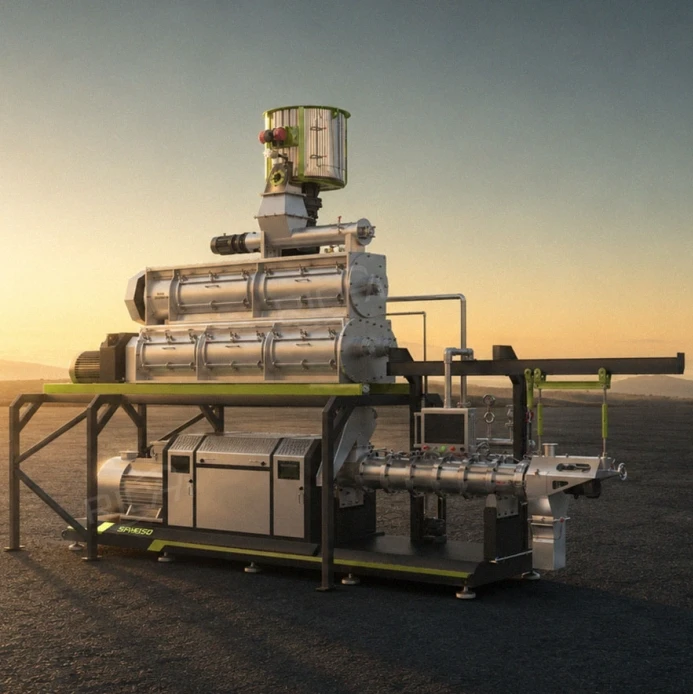
Extrusion is the central process for making floating fish feed.
The prepared mixture enters the extrusion chamber, where mechanical pressure, heat, moisture, and friction change the physical structure of the material.
One important effect is the transformation of starch under controlled processing conditions.
When the material leaves the die, pressure drops rapidly. Water in the hot material can partially turn into steam, causing the extruded feed to expand.
This expansion creates small pores inside the pellet.
The resulting structure can reduce bulk density and allow the pellet to float on water.
This is why extrusion is different from conventional pellet pressing. A traditional pellet mill mainly compresses material into a dense pellet, while extrusion can also control expansion and density.
A floating fish feed extruder machine therefore needs to be selected according to the formula, required pellet diameter, moisture conditions, production capacity, and desired floating characteristics.
What Factors Affect Floating Performance?
Floating performance does not depend on the extruder alone.
The feed formula has a major influence.
Starch content, protein sources, fiber levels, moisture, and other ingredients can change the way the material expands.
Moisture also needs to be controlled carefully. Too little moisture can make extrusion unstable, while excessive moisture may affect expansion and increase the load on downstream drying equipment.
Temperature and pressure are also important.
The operator needs to find a processing range that provides stable expansion without damaging the nutritional characteristics of the feed.
Die size affects pellet diameter, while cutter settings influence pellet length.
Because all these variables interact, the production process usually needs to be adjusted according to the specific formula rather than following one fixed setting for every feed product.
Does Floating Feed Need Drying?
Freshly extruded pellets normally contain more moisture and heat than the final packaged product should have.
A drying system can reduce excess moisture and improve storage stability.
Drying conditions need to be controlled carefully. Over-drying wastes energy and can affect the physical properties of the pellets. Under-drying may leave too much moisture in the product and reduce its storage stability.
The dryer should therefore be matched to the extruder output.
This is particularly important for a continuous production line. If the extruder produces more wet pellets than the dryer can process, the dryer becomes a bottleneck.
The opposite situation can also occur. An oversized dryer may increase the investment cost without providing a practical benefit.
For this reason, drying capacity should be considered together with extrusion capacity.
Why Is Cooling Necessary?
After drying, the pellets still need to be cooled before packaging.
Cooling reduces product temperature and helps stabilize the pellets.
If hot feed is packed immediately, condensation can develop inside the package as the product temperature changes. Excess moisture inside a sealed bag can create storage problems.
A suitable cooling process allows the finished feed to reach a more appropriate temperature before packaging.
Cooling also makes the product easier to handle during screening and bagging.
For a larger production plant, continuous cooling equipment can be integrated with conveyors and screening systems to create a smooth material flow.
What Is the Purpose of Screening?
Screening separates qualified pellets from fines and particles that do not meet the required specification.
This improves the appearance and consistency of the finished product.
Fines can occur during extrusion, drying, cooling, conveying, and handling. A screening machine can remove these particles before packaging.
Depending on the production process, the separated fines may be returned to the production system.
The screen opening should correspond to the pellet size and product requirements.
For example, a feed plant producing several pellet diameters may need different screening configurations for different products.
Screening is therefore a relatively simple process, but it plays an important role in maintaining consistent final quality.
How Should a Small Feed Factory Be Arranged?
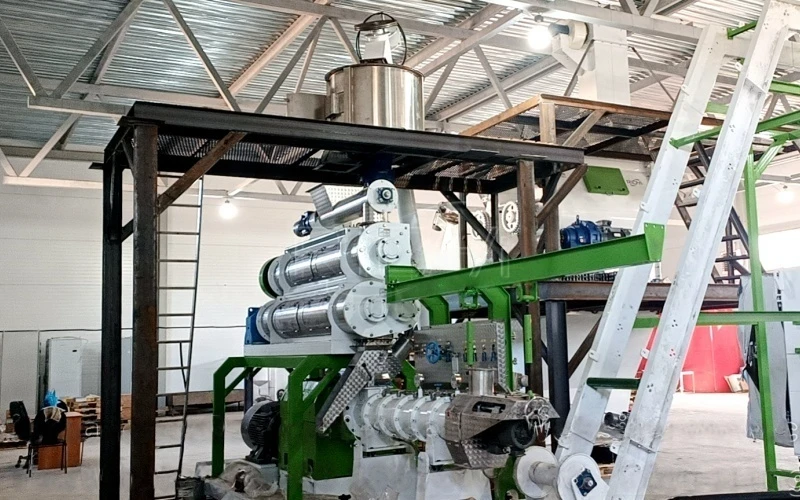
Factory layout should be planned before equipment installation.
Raw materials normally enter the plant through a receiving area and move toward storage and processing.
The production flow should then follow a logical sequence:
Raw material storage → grinding → batching → mixing → extrusion → drying → cooling → screening → packaging → finished product storage
This arrangement reduces unnecessary material movement.
It also makes the production process easier for operators to understand.
The layout should provide enough space around major machines for inspection and maintenance. Motors, bearings, gearboxes, electrical cabinets, and wear parts should remain accessible.
Dust control is another consideration around grinding and material transfer areas.
For a larger plant, conveyors and elevators can reduce manual handling. For a small plant, some manual operations may still be economical if labor costs are relatively low.
The best layout is therefore not necessarily the most automated one. It is the layout that matches the project’s production volume and operating conditions.
Should a Fish Farm Produce Its Own Feed?
Some fish farms choose to produce feed internally instead of purchasing all their feed from external suppliers.
The main reason is greater control.
Farm operators can adjust the feed formula according to fish species, growth stage, local ingredient availability, and seasonal requirements.
Producing feed internally may also provide more flexibility when commercial feed prices change.
However, an on-site feed plant also creates additional work.
The farm needs to purchase and store raw materials, maintain equipment, manage formulas, monitor production quality, and train operators.
Electricity, maintenance, labor, and spare parts also become part of the operating cost.
Therefore, the decision should be based on actual feed consumption.
If a farm consumes only a small quantity of feed, purchasing commercial products may remain more economical. If feed consumption is large and stable, an internal production system may become more attractive.
What Should Commercial Feed Producers Consider?
Commercial producers need to look beyond their current demand.
A new plant may initially produce a limited number of feed products, but the market may require additional pellet sizes or formulas later.
The production line should therefore have reasonable flexibility.
For example, the same extrusion system may need to produce different pellet diameters during different production runs.
Changeover time, die replacement, cleaning, and operating adjustments should be considered during equipment selection.
Storage capacity is also important.
Raw materials should be stored under suitable conditions to prevent moisture and contamination. Finished feed needs enough warehouse space to avoid disrupting production.
A company planning commercial sales should also consider packaging formats. Small retail bags and large bulk bags require different packaging arrangements.
How Important Is Technical Support?
Equipment selection is only one part of establishing a feed production project.
Installation, commissioning, operator training, process adjustment, spare parts, and maintenance support can also influence how quickly a new plant reaches stable operation.
This is especially important for companies that have limited experience with extrusion technology.
A supplier that understands the complete production process can help coordinate equipment capacity and material flow. Technical support can also help operators understand how changes in formula, moisture, or pellet size affect machine operation.
For companies planning a new feed project, these services can be just as important as the equipment itself. Buyers can click for more information about project design, installation support, technical assistance, and related services.
How Should Buyers Choose an Equipment Supplier?
Buyers should compare suppliers based on more than the initial machine price.
The first question is whether the supplier understands the actual raw materials and feed formulas.
The second is whether the proposed equipment capacity matches the required production target.
The third is whether the supplier can provide a complete process solution rather than only selling individual machines.
After-sales support should also be considered.
A machine may operate for many years, but wear parts eventually need replacement. Operators may also need technical assistance when changing formulas or pellet specifications.
Working with an experienced supplier can reduce the risk of choosing equipment that looks suitable on paper but does not perform as expected under actual production conditions.
For international buyers, communication is another practical factor. Clear technical documentation, spare parts support, installation guidance, and remote assistance can make project management easier.
Why Is Complete Line Design Better Than Buying Machines Separately?
A fish feed plant consists of multiple connected processes.
If one machine has significantly lower capacity than the others, it can become a bottleneck.
For example, a high-capacity extruder will not increase overall production if the dryer cannot handle the same amount of material.
Similarly, a large packaging system does not provide much benefit when upstream equipment produces insufficient finished feed.
A complete production line should therefore be designed around the target output.
The supplier should consider the capacity of grinding, batching, mixing, extrusion, drying, cooling, screening, conveying, and packaging equipment as one system.
This approach also makes factory layout and future expansion easier to manage.
A Practical Approach to Starting the Project
Before ordering equipment, buyers can prepare a basic project specification.
The document should include the following information:
- Target production capacity
- Fish species
- Feed formula
- Raw material types
- Raw material moisture
- Required pellet diameter
- Floating requirements
- Working hours per day
- Packaging size
- Available factory space
- Local electricity conditions
- Expected future capacity
With this information, an equipment supplier can provide a more realistic production-line proposal.
For example, a company planning a 2 to 3 T/H project should not simply ask for the cheapest available machine. It should ask whether the complete system can continuously produce the required amount of finished feed under the intended formula.
This approach makes equipment comparison much more meaningful.
Final Thoughts
A successful floating fish feed project depends on the relationship between raw materials, formula, processing technology, equipment capacity, and operating conditions.
The extrusion process is important because it controls pellet expansion and can produce feed with suitable floating characteristics. However, extrusion cannot compensate for poor grinding, uneven mixing, incorrect moisture, or inadequate drying.
The entire production line needs to work as a coordinated system.
For small farms, a compact line may be sufficient. For commercial producers, automated material handling, accurate batching, continuous drying and cooling, and automatic packaging may provide better long-term efficiency.
When evaluating suppliers, buyers should look at the complete project rather than focusing only on one machine or the lowest purchase price. Richi Machinery can provide a reference point for companies comparing fish feed processing equipment and complete production solutions.
The right investment is ultimately the one that matches the actual feed formula, production target, available space, and future business plans. A well-planned production line can provide greater flexibility while helping operators maintain stable feed quality as the business grows.