
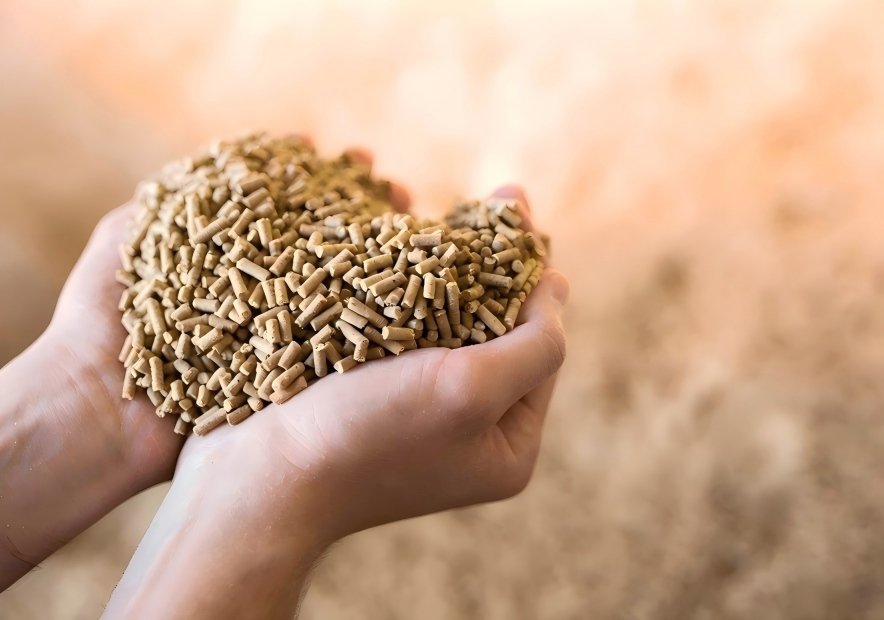
Cattle feed quality directly affects animal growth, milk production, feed efficiency, health, and farm profitability. As cattle farming becomes more intensive and feed costs continue to represent a major part of production expenses, producers are paying greater attention to how feed is processed, not only what ingredients are used.
Modern cattle feed production technology integrates raw material cleaning, crushing, batching, mixing, conditioning, pelleting, cooling, screening, coating, and packaging into a controlled production process. Each stage has a specific role in improving the physical and nutritional quality of the final feed. Proper processing can make nutrients more accessible, improve pellet durability, reduce ingredient separation, and provide cattle with a more consistent diet.
For commercial feed manufacturers and large livestock farms, equipment selection is therefore an important part of feed quality management. A well-designed cattle feed production line can provide stable processing conditions while adapting to different formulas, raw materials, pellet sizes, and production capacities.
What Is Cattle Feed Production Technology?
Cattle feed production technology refers to the methods, equipment, and process controls used to convert agricultural ingredients into complete or supplementary cattle feed.
Depending on the feeding system and formulation, cattle feed may contain ingredients such as:
- Corn and other grains
- Barley
- Wheat and wheat bran
- Soybean meal
- Sunflower meal
- Cottonseed cake
- Rice bran
- Molasses
- Alfalfa
- Grass hay
- Straw
- Silage
- Date pulp
- Mineral supplements
- Vitamins and other feed additives
These ingredients have different particle sizes, moisture levels, densities, fiber contents, and physical characteristics. Simply combining them does not necessarily produce high-quality feed.
Production technology creates controlled conditions that help transform these ingredients into a uniform and easy-to-handle feed product.
For example, crushing can reduce particle size, mixing can distribute nutrients evenly, conditioning can improve moisture and temperature, and pelleting can compact the formula into dense particles. Cooling and screening then help stabilize the pellets before storage and transportation.
The result is a more consistent feed product with improved physical properties.
1. Proper Raw Material Cleaning Improves Feed Safety
The first step in many cattle feed production lines is raw material cleaning.
Grains, forage, oilseed meals, and agricultural byproducts may contain foreign materials such as stones, metal fragments, dust, sand, fibers, and other impurities. If these materials enter downstream equipment, they can reduce product quality and cause equipment damage.
Cleaning systems commonly use screens, magnets, aspiration systems, or combinations of different separation technologies.
Removing unwanted materials provides several benefits.
First, it improves the cleanliness of the final feed. Second, it protects crushers, mixers, pellet mills, and other equipment from excessive wear. Third, it creates more stable processing conditions.
For commercial cattle feed manufacturers, raw material cleaning is particularly important because ingredients may come from different suppliers and have varying levels of contamination.
A well-designed cleaning process therefore provides a foundation for consistent feed quality.
2. Crushing Creates a More Uniform Particle Size
Particle size has an important influence on cattle feed quality.
Large pieces of grain, straw, hay, or other ingredients may be difficult to mix evenly. Extremely coarse particles can also reduce pellet quality because they are harder to compress into a dense and stable pellet.
A hammer mill or other suitable grinder can reduce raw materials to the required particle size.
The appropriate size depends on the formula and final feed type. Grain-based concentrate feed may require relatively fine grinding, while roughage-containing cattle feed may use a different particle-size distribution.
The objective is not simply to make everything as fine as possible. Excessive grinding can increase energy consumption and may not always improve feed performance.
Modern production systems therefore focus on achieving an appropriate and consistent particle size.
A controlled crushing process helps:
- Improve mixing uniformity
- Increase contact between ingredients
- Improve pellet formation
- Reduce ingredient separation
- Create more consistent feed texture
- Improve the efficiency of subsequent processing
For formulas containing fibrous ingredients, crushing equipment must also be selected according to the characteristics of the raw material.
3. Accurate Batching Improves Nutritional Consistency
Cattle diets are formulated to provide specific levels of energy, protein, fiber, minerals, and other nutrients.
Even a well-designed formula can fail to deliver the intended nutritional profile if ingredients are not accurately measured.
Modern cattle feed plants therefore use batching and weighing systems to control the quantity of each ingredient entering the production process.
For example, a feed manufacturer may formulate a cattle feed using corn, barley, soybean meal, wheat bran, cottonseed cake, molasses, and mineral premixes. Each component needs to be added according to the formula.
Accurate batching helps ensure that one batch does not contain significantly more or less of a particular ingredient than another.
This consistency is particularly important for commercial feed production because cattle may receive the same formulated product over a long period.
Stable batching contributes to:
- Consistent nutrient levels
- Repeatable feed quality
- Better formula control
- Reduced raw material waste
- More reliable production costs
Automated batching systems can further reduce human error and improve production efficiency.
4. Mixing Technology Improves Feed Uniformity
After ingredients are crushed and accurately weighed, they need to be mixed thoroughly.
A high-quality mixer distributes ingredients throughout the batch so that each portion of feed has a similar composition.
This is especially important when a formula contains small quantities of vitamins, minerals, additives, or other micro-ingredients. Poor mixing can result in some feed portions containing excessive amounts of an additive while others contain too little.
Different mixers may be used depending on the production capacity and formulation characteristics. Horizontal mixers, paddle mixers, and other industrial designs can provide different mixing characteristics.
The ideal mixing process should achieve sufficient uniformity without causing excessive segregation.
Mixing time, filling level, ingredient sequence, moisture, and mixer design can all affect results.
For formulas containing molasses or other sticky ingredients, the production process may require additional consideration because these components can influence material flow and mixing performance.
5. Conditioning Helps Prepare Feed for Pelleting
Conditioning is one of the important steps in modern cattle feed pellet production.
Before entering the pellet mill, the feed mixture can be exposed to controlled moisture and heat, often through steam conditioning.
During conditioning, moisture penetrates the feed particles while temperature increases. This changes the physical characteristics of the feed material and helps prepare it for compression.
Proper conditioning can improve:
- Pellet formation
- Pellet durability
- Production stability
- Binding between particles
- Throughput
- Reduction of fines
Conditioning can also influence the processing of different raw materials.
For example, formulas containing grains may respond differently from formulas containing large amounts of forage or fibrous materials. Therefore, conditioning parameters should be adjusted according to the feed formulation and desired pellet characteristics.
The objective is to achieve appropriate moisture and temperature conditions without negatively affecting heat-sensitive nutrients.
6. Pelleting Improves the Physical Quality of Cattle Feed
Pelleting is one of the most widely used technologies in commercial cattle feed production.
Instead of leaving the feed as a loose mixture, the feed material is compressed through a die to form uniform cylindrical pellets.
Pelletizing can significantly improve the physical characteristics of feed.
Loose feed may separate during transportation because different ingredients have different densities and particle sizes. Pellets hold many ingredients together in a compact form, reducing this type of separation.
Pellets are also easier to transport, store, and handle using automated feeding systems.
A well-produced cattle feed pellet should have appropriate:
- Diameter
- Length
- Hardness
- Density
- Durability
- Moisture content
- Fines level
The correct pellet size depends on factors such as cattle category, feeding method, formula, and customer requirements.
Calves, growing cattle, dairy cattle, beef cattle, and other livestock groups may require different feed specifications.
7. The Role of the Cow Feed Pellet Making Machine
The pellet mill is a core piece of equipment in many cattle feed production lines.
A cow feed pellet making machine compresses the prepared feed mixture through a die to produce compact cattle feed pellets.
The performance of the machine affects pellet quality, production capacity, energy consumption, and operational stability.
When selecting a cow feed pellet making machine, manufacturers should consider several factors.
Raw Material Characteristics
The machine should match the formula being processed. Grain-based feed, high-fiber feed, roughage feed, and mixed cattle feed can have different pelleting characteristics.
Pellet Diameter
Different cattle feed products may require different pellet sizes. The die should therefore be selected according to the target pellet diameter.
Production Capacity
Small farms may require a relatively low-capacity machine, while commercial feed mills may need several tons per hour or more.
Selecting equipment according to actual production requirements helps avoid unnecessary investment or insufficient capacity.
Die and Roller System
The die and roller assembly is directly involved in pellet formation. Wear-resistant components can help maintain stable pellet production over time.
As the die and rollers wear, compression conditions can change and pellet quality may decline. Regular inspection and timely maintenance are therefore important.
Drive System
A stable drive system helps maintain consistent operating conditions under changing loads. This is particularly important when processing formulas with high fiber or high-density ingredients.
Safety and Lubrication
Automatic lubrication systems can reduce manual maintenance requirements, while overload protection helps protect critical components from unexpected operating conditions.
A properly selected pellet mill therefore does more than simply produce pellets. It becomes part of an integrated quality-control process.
(Learn more: https://richipelletizer.com/cattle-feed-pellet-mill-for-sale/)
8. Pellet Durability Reduces Fines
One of the major physical-quality indicators of pelleted cattle feed is pellet durability.
During conveying, loading, transportation, and storage, pellets may experience impact and friction. Weak pellets can break apart and generate excessive fines.
High levels of fines can lead to:
- Feed waste
- Dust
- Uneven feeding
- Reduced product appearance
- Increased handling problems
- Separation during transportation
Conditioning, grinding, formulation, moisture control, die selection, and pellet mill operation all influence pellet durability.
A good production process therefore considers the entire system rather than trying to solve pellet breakage through the pellet mill alone.
9. Cooling Stabilizes Fresh Pellets
Fresh pellets usually leave the pellet mill at an elevated temperature and may contain more moisture than the final product specification allows.
A pellet cooler is therefore normally installed after the pellet mill.
Cooling reduces pellet temperature and helps remove excess moisture.
This is important because storing warm or overly moist feed can increase the risk of quality deterioration.
A counterflow cooler or other suitable cooling system can bring pellets closer to ambient temperature while improving their physical stability.
Proper cooling helps:
- Reduce pellet temperature
- Lower moisture to a suitable level
- Improve storage stability
- Reduce condensation risks
- Prepare pellets for screening and packaging
Cooling performance should be matched to production capacity and pellet characteristics.
10. Screening Removes Excess Fines
After cooling, cattle feed pellets may pass through a vibrating screen or another screening system.
Screening separates qualified pellets from broken particles and fines.
The acceptable product can then move toward packaging, while undersized material may be returned to the production process.
This creates a more consistent finished product.
Screening is especially useful for commercial feed manufacturers that need to maintain a consistent appearance and particle-size distribution.
The combination of pelleting, cooling, and screening allows the production line to deliver feed with a controlled final specification.
11. Coating Technology Can Improve Feed Functionality
Some cattle feed formulas contain liquid ingredients or additives that are better applied after pelleting.
Coating systems can spray materials such as oils, certain liquid nutrients, or other approved additives onto the pellet surface.
Post-pellet coating can provide greater flexibility in feed production because certain ingredients may not be suitable for exposure to the temperatures or pressures inside the pellet mill.
For example, some heat-sensitive components may be added after cooling.
The exact coating strategy depends on the formula, product requirements, and nutritional formulation.
12. Moisture Control Supports Feed Storage
Moisture is closely related to feed stability.
If cattle feed contains excessive moisture, it may become more susceptible to quality deterioration during storage. If the feed is excessively dry, unnecessary energy may have been consumed during processing and handling characteristics may also change.
Modern production lines therefore monitor moisture at different stages.
Important control points may include:
- Incoming raw materials
- After conditioning
- After pelleting
- After cooling
- Before packaging
Moisture management should not be treated as a single-stage operation.
Instead, it should be controlled throughout the production process.
13. Automation Improves Production Consistency
Automation is increasingly important in large cattle feed plants.
A modern control system can monitor and manage equipment such as:
- Raw material receiving systems
- Cleaning equipment
- Crushers
- Batching systems
- Mixers
- Conditioners
- Pellet mills
- Coolers
- Screens
- Packing machines
Automation can improve consistency by reducing manual intervention and allowing operators to monitor production parameters.
For example, the system can control ingredient quantities according to a predefined formula and coordinate equipment operation according to production requirements.
Data collection can also help operators identify abnormal conditions and optimize production.
The degree of automation should be selected according to production capacity, labor availability, investment budget, and management requirements.
14. Different Cattle Feeds Require Different Technologies
There is no single processing method suitable for every cattle feed formula.
Dairy cattle feed may emphasize energy, protein, minerals, and other nutritional requirements. Beef cattle feed may have a different formulation. Young cattle may require different pellet specifications from mature animals.
Likewise, roughage-based feed behaves differently from concentrate feed.
For example, a feed formula containing large quantities of alfalfa, grass hay, straw, or other fibrous materials may require different crushing, conditioning, and pelleting conditions than a grain-heavy formula.
Therefore, a cattle feed production line should be designed around the actual formula and raw materials rather than based only on production capacity.
15. Technology Helps Process Agricultural Byproducts
Modern cattle feed technology also allows manufacturers to make better use of agricultural byproducts.
Depending on local availability and nutritional formulation, ingredients such as rice bran, wheat bran, cottonseed cake, sunflower meal, date pulp, and other byproducts can be incorporated into cattle feed.
These materials often have different physical characteristics.
Some may be fibrous, some may contain relatively high oil levels, and others may be sticky or difficult to process.
A properly designed production line can use appropriate crushing, mixing, conditioning, and pelleting systems to process these materials into a more uniform feed product.
This can increase raw material flexibility while helping feed manufacturers develop formulas based on locally available resources.
16. Feed Production Technology Improves Handling and Transportation
Feed quality is not only about nutritional composition.
Physical handling characteristics are also important.
Pelleted cattle feed generally has a more uniform shape and density than loose mixed feed. This makes it easier to transport using conveyors, elevators, trucks, and automated feeding systems.
The compact structure also reduces the volume occupied by the same quantity of feed compared with some loose materials.
For commercial feed manufacturers, better handling characteristics can simplify:
- Bulk transportation
- Bagging
- Warehouse management
- Loading and unloading
- Automated feeding
- Distribution
Stable pellets can also reduce material losses during transportation.
17. Quality Control Should Cover the Entire Production Line
High-quality cattle feed cannot be produced by focusing on one machine alone.
A feed mill should establish quality-control points throughout the production process.
Raw Material Control
Check incoming ingredients for cleanliness, moisture, particle size, and other relevant specifications.
Grinding Control
Monitor particle size and crusher performance.
Batching Control
Verify ingredient quantities against the formulation.
Mixing Control
Evaluate the uniformity of the finished mixture.
Conditioning Control
Monitor temperature and moisture conditions.
Pelleting Control
Check pellet diameter, durability, production rate, and fines.
Cooling Control
Verify temperature and moisture after cooling.
Final Product Control
Inspect pellet appearance, size, moisture, durability, packaging, and other customer-specific specifications.
This process-based approach helps manufacturers identify quality problems before they become large-scale production issues.
18. Energy Efficiency Also Affects Feed Production Economics
Feed quality and production efficiency are closely connected to energy consumption.
Crushing, mixing, conditioning, pelleting, drying, cooling, and conveying all require energy.
An inefficient production line may consume excessive electricity or steam while producing inconsistent feed.
Modern equipment can improve efficiency through optimized drive systems, appropriate motor selection, automatic control, efficient conditioning, and optimized process layouts.
However, energy efficiency should not be evaluated independently from feed quality.
For example, reducing conditioning excessively to save energy could negatively affect pellet durability. Similarly, insufficient grinding could reduce pelleting performance.
The objective should be to balance energy consumption, production capacity, pellet quality, and operating stability.
19. Customized Production Lines Improve Feed Quality
Because cattle feed formulas vary significantly, customized production-line design can provide important advantages.
A small farm producing one simple formula may only require basic crushing, mixing, pelleting, cooling, and packaging equipment.
A large commercial feed manufacturer may need multiple raw material receiving systems, automated batching, several crushing stages, premix systems, multiple mixers, conditioning systems, pellet mills, cooling and screening systems, and automated packaging.
A customized solution can consider:
- Raw material types
- Formula characteristics
- Target pellet size
- Required capacity
- Factory layout
- Degree of automation
- Energy supply
- Labor availability
- Packaging requirements
- Future production expansion
This approach allows equipment and process parameters to be matched to actual production requirements.
20. Turnkey Engineering Connects Equipment With Process Technology
For investors planning a complete cattle feed factory, buying individual machines is only one part of the project.
The arrangement and interaction of equipment also influence production quality.
A turnkey cattle feed project can integrate raw material handling, cleaning, crushing, batching, mixing, pelleting, cooling, screening, packaging, electrical control, and other systems into one coordinated solution.
The engineering process may include:
- Raw material and formula analysis
- Production capacity confirmation
- Process flow design
- Equipment selection
- Factory layout planning
- Equipment manufacturing
- Transportation and installation
- Commissioning
- Operator training
- After-sales technical support
This integrated approach helps ensure that individual machines work together rather than operating as disconnected components.
(investigate this site:RICHI PELLETIZER)
21. How to Choose the Right Cattle Feed Production Equipment
When planning a cattle feed production line, investors should consider more than the machine price.
First, determine the required production capacity. A plant designed for 2 tons per hour has different equipment requirements from one designed for 20 tons per hour.
Second, analyze the raw materials. Grain-based formulas, high-fiber formulas, TMR-type feed, and mixed concentrate feed can require different processing conditions.
Third, determine the required pellet diameter. Common cattle feed pellet sizes may vary depending on the animal category and feeding system.
Fourth, consider the level of automation. Manual systems may be appropriate for small-scale operations, while large commercial plants generally benefit from higher automation.
Fifth, evaluate maintenance requirements and spare-part availability.
Finally, consider whether the equipment supplier can provide complete process design and technical support rather than only individual machines.
22. Common Problems Caused by Poor Feed Processing
Poor production technology can lead to several feed-quality problems.
Excessive Fines
May result from poor conditioning, inappropriate grinding, worn dies or rollers, insufficient compression, or improper cooling.
Uneven Pellets
May be associated with inconsistent raw material particle size, unstable feed supply, or unsuitable die selection.
Ingredient Separation
Often occurs when loose feed is poorly mixed or when pellets are not sufficiently stable.
Excessive Moisture
Can result from improper conditioning or inadequate cooling.
Low Production Capacity
May occur when the pellet mill is overloaded, raw materials are difficult to process, or upstream equipment cannot supply material consistently.
High Energy Consumption
Can be caused by inefficient grinding, unsuitable equipment sizing, excessive recirculation, or poor process design.
These problems demonstrate why feed quality should be managed through the entire production system.
23. Future Trends in Cattle Feed Production
Cattle feed production is increasingly moving toward automation, digital monitoring, energy optimization, and more flexible formulations.
Smart control systems can collect production data and help operators monitor equipment performance.
Automated weighing and batching can improve formula consistency. More efficient motors and drive systems can reduce energy consumption. Improved pellet mill designs can increase production stability.
At the same time, feed manufacturers are increasingly interested in processing locally available agricultural resources and developing formulas that meet specific livestock production objectives.
These trends make process engineering increasingly important.
The future of cattle feed production will not simply depend on having larger machines. It will depend on integrating equipment, formulation, process control, quality management, and factory operation into an efficient production system.
Conclusion
Cattle feed production technology plays an important role in improving both the nutritional consistency and physical quality of cattle feed. Cleaning removes impurities, crushing creates an appropriate particle size, accurate batching controls ingredient proportions, and mixing improves feed uniformity. Conditioning prepares the material for pelleting, while a properly selected cow feed pellet making machine produces compact and consistent pellets.
Cooling, screening, coating, packaging, and automated control then complete the production process and help maintain finished-feed quality.
For cattle feed manufacturers, the key is to view feed production as an integrated system rather than a collection of individual machines. Raw materials, feed formulas, capacity, pellet specifications, equipment configuration, and quality-control procedures should all work together.
A properly engineered cattle feed production line can provide more consistent feed quality, improve handling characteristics, reduce production losses, and support stable long-term operation. For investors planning a new cattle feed factory or upgrading an existing facility, selecting the right processing technology and designing the production line around actual feed requirements are essential steps toward reliable and efficient cattle feed production.