
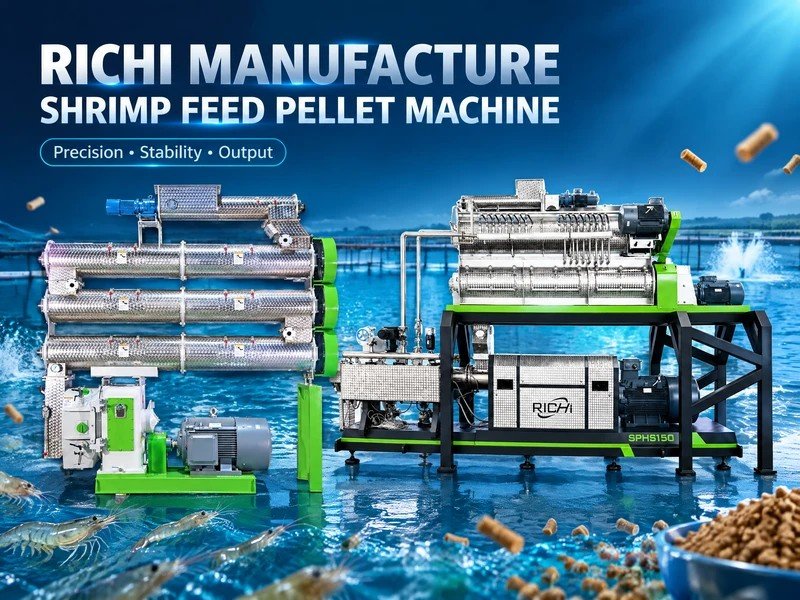
Aquaculture businesses increasingly need feed that matches the biological requirements of different species while remaining practical to manufacture at commercial scale. Shrimp farming is particularly demanding because feed must be properly formed, nutritionally consistent, and stable enough in water to reduce unnecessary losses. For this reason, choosing the right shrimp feed pellet machine is an important part of planning an aquatic feed operation.
Why Shrimp Feed Requires Specialized Processing
Shrimp feed is not simply a smaller version of conventional livestock feed. Shrimp generally require relatively small pellets, and the physical properties of those pellets influence how efficiently the animals can consume the feed. If pellets break apart too quickly after entering the water, valuable nutrients may be lost and uneaten material can accumulate in the farming environment.
The production process therefore needs to consider raw material particle size, formulation, moisture, conditioning, compression, pellet cutting, cooling, and screening. Each stage influences the final characteristics of the product. Fine grinding can help improve pellet formation, while effective conditioning allows moisture and steam to interact more evenly with the feed mixture before pelleting.
A properly configured pelleting system also allows manufacturers to adjust pellet dimensions according to the requirements of different shrimp growth stages. Ring dies with different hole sizes can be selected when different pellet diameters are required, while cutter settings and operating conditions can further influence pellet length.
Connecting Shrimp Feed With Broader Aquatic Feed Production
For companies serving several aquaculture markets, shrimp feed may be only one part of a larger production strategy. Fish feed and shrimp feed often share several processing stages, including grinding, batching, mixing, conveying, pelleting, cooling, screening, and packaging. This makes it possible for an aquatic feed factory to develop a flexible production system instead of building completely independent facilities for every product.
A broader 1-120t/h fish feed mill plant concept can therefore be considered when the business expects to produce multiple types of aquatic feed. The actual configuration should be based on the intended products, raw materials, capacity, pellet specifications, and available factory conditions rather than selecting equipment only according to a nominal capacity.
From Raw Materials to Finished Pellets
A typical process begins with receiving and preparing ingredients. Protein meals, grains, binders, oils, additives, vitamins, and other ingredients may require different handling methods. Grinding reduces particle size, while a weighing and batching system helps maintain formulation accuracy. Mixing then distributes the ingredients before the material enters the conditioning and pelleting stages.
After forming, freshly produced pellets normally contain heat and moisture. Cooling helps stabilize them before screening removes oversized or excessively broken particles. Finished feed can then move toward automatic weighing and packaging equipment.
What Should Buyers Examine?
Capacity is only one consideration when selecting a feed processing system. Buyers should also examine the required pellet diameter, feed type, formulation characteristics, moisture level, expected operating schedule, available power supply, and future expansion plans.
Equipment accessibility is another practical consideration. Wear components such as dies, rollers, cutters, and other contact parts eventually require inspection or replacement. A production line designed with maintenance access in mind can make routine servicing more manageable.
Building for Future Demand
Aquaculture markets can change as farms expand or producers introduce new species and feed formulations. A modular approach may allow a business to add equipment or increase processing capacity later without completely rebuilding the facility.
For businesses researching suppliers, look at here now can be a useful reminder that equipment selection should involve more than comparing machine prices. Technical support, engineering experience, spare-parts availability, installation assistance, and process knowledge can all influence the long-term usability of a feed production system.
Working With an Experienced Equipment Partner
The supplier’s role becomes particularly important when a project involves several processing stages. Richi manufacture develops pellet processing equipment and complete production solutions for different applications, allowing customers to discuss equipment configuration according to their specific production objectives.
For an expanding aquaculture business, the goal is not simply to purchase a pellet mill. The more important task is to establish a coordinated processing system in which material moves smoothly from preparation to finished feed. When equipment, process design, capacity planning, and future expansion are considered together, a shrimp feed project can be developed around the actual needs of the farm or commercial feed producer.
View details: https://www.richimanufacture.com/shrimp-feed-pellet-machine/