
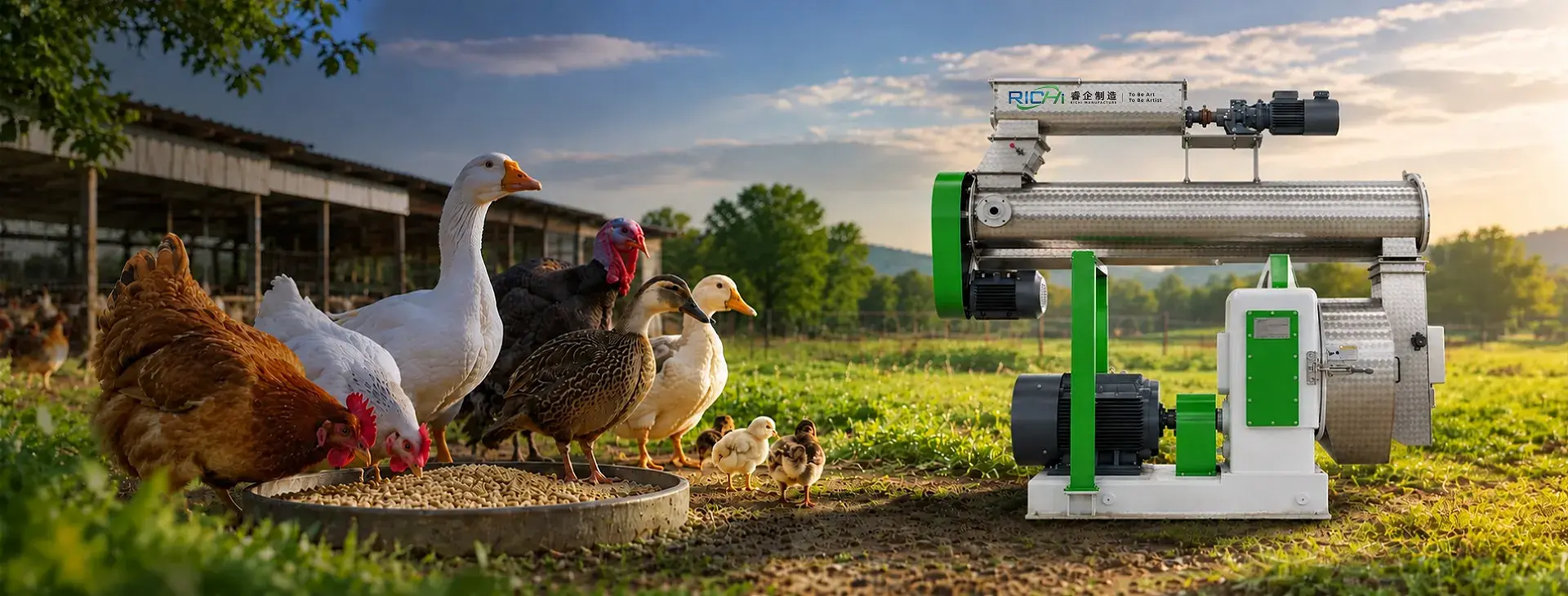
Feed is often the single largest cost in poultry farming. For small and mid-sized farms, buying finished feed from a commercial mill is simple, but it leaves the farm exposed to price swings, transport costs, and supply delays. Producing feed on site changes that equation. It is not a decision to take lightly, though. It affects how you store grain, how you mix ingredients, how much labor you need, and how consistent your flocks perform.
This article looks at what on-site feed production actually involves for a poultry farm. It covers raw materials, process choices, cost structure, equipment matching, and the practical issues that decide whether a small feed line pays off.
Why More Farms Are Looking at Feed Production
Poultry production has become more competitive almost everywhere. Margins per bird are thin, and feed typically accounts for 60 to 70 percent of total production cost. When commercial feed prices rise, farms with no production capacity of their own have few options. They can absorb the loss, cut flock size, or pass costs downstream. None of those are attractive.
On-site production gives a farm more control. It can use locally available grain, adjust formulas as ingredient prices change, and reduce dependence on a single supplier. For farms in remote areas, the transport cost alone can justify a small line. For farms near grain producers, the advantage is even clearer.
There is also a quality angle. Commercial feed is formulated for broad use. A farm that mixes its own feed can adjust protein, energy, and mineral levels to match its birds, its climate, and its production goals. That flexibility matters more than many farmers expect.
Understanding What Poultry Actually Need
Before choosing any equipment, it helps to understand what a poultry diet actually contains. Most poultry feed is built around a few core components.
Energy sources. Corn, wheat, sorghum, and occasionally cassava or other roots provide the bulk of energy. Corn is the most common base in many regions because of its high energy density and consistent supply.
Protein sources. Soybean meal is the standard, but farms also use rapeseed meal, sunflower meal, fish meal, and increasingly insect protein. Protein level depends on the bird and its stage of production. Layers need different protein than broilers, and chicks need different protein than adult birds.
Minerals and additives. Limestone, dicalcium phosphate, salt, and premixes supply calcium, phosphorus, and trace elements. These are small in volume but critical in function. A laying hen with insufficient calcium will produce weak shells regardless of how good the rest of the diet is.
Fiber and fillers. Some formulas include bran, hulls, or other fibrous materials. These help with digestion and can reduce cost, but too much fiber lowers energy density.
The exact formula varies by region, by bird type, and by what is locally available. A farm in Southeast Asia may build around rice bran and cassava. A farm in Europe may build around wheat and soy. The principle is the same: match the formula to the birds and the local supply.
Raw Material Handling Comes First
A common mistake among new feed producers is to focus on the mixer or the pellet mill and ignore raw material handling. In practice, handling is where most small plants run into trouble.
Grain arrives with moisture, dust, and foreign matter. If it is stored without proper drying or ventilation, it can mold, and moldy grain ruins feed quality. A small farm needs at least a basic drying and storage plan before it thinks about mixing.
Grinding is the next step. Poultry digest feed better when particle size is consistent. A hammer mill or similar grinder reduces grain to a uniform size. The screen size affects the final texture. Too coarse, and birds sort the feed and waste ingredients. Too fine, and feed becomes dusty and difficult to handle.
Mixing follows grinding. A horizontal mixer or vertical mixer blends the ground grain with protein meals, minerals, and additives. Mixing time and uniformity matter more than most people realize. A poorly mixed batch means some birds get too much of a nutrient and others get too little, even though the average looks correct on paper.
For farms that want pelleted feed, a poultry feed machine adds another step. Pelleting improves feed density, reduces waste, and makes handling easier. It also requires steam conditioning, cooling, and sometimes crumbling, which adds equipment and cost. Not every small farm needs pellets, but for farms selling feed or feeding large flocks, pellets often make sense.
Choosing Between Mash, Crumbles, and Pellets
Poultry feed comes in three basic forms, and the choice affects both equipment and cost.
Mash is the simplest form. Ground ingredients are mixed and fed directly. It requires the least equipment and the lowest investment. The downside is that birds can sort the feed, and fine particles are easily wasted. Mash works well for small flocks and for farms that want to minimize capital cost.
Crumbles are pelleted feed that has been broken into smaller pieces. They are common for chicks and young birds because they are easier to eat than full pellets. Producing crumbles requires a pellet mill plus a crumbler, which increases cost.
Pellets are the most processed form. Pelleting gelatinizes starch, improves digestibility, and reduces waste. Pellets are easier to store and transport, and they work well in automatic feeding systems. The trade-off is higher equipment cost, higher energy use, and the need for more careful moisture control.
For a small farm, the decision usually comes down to flock size and labor. A farm feeding a few hundred birds can often use mash and avoid the cost of pelleting equipment. A farm feeding several thousand birds, or one that sells feed to neighbors, will usually find pellets worth the investment. This is where a small poultry feed making machine for sale becomes relevant, because the equipment needs to match the intended scale rather than exceed it.
Matching Equipment to Real Capacity
One of the most common problems in small feed projects is over-equipment. A farm buys a line rated for far more than it needs, then struggles with power supply, labor, and maintenance. The result is a plant that runs at a fraction of capacity and never pays back.
Capacity should be calculated from actual feed demand. A farm with 5,000 layers might need roughly 500 to 600 kilograms of feed per day, depending on bird weight and production stage. That is about 15 to 18 tons per month. A farm with 20,000 broilers will have different demand, and the demand changes as birds grow.
The equipment line should match that demand with some room for growth, but not so much room that the farm is running a large machine for a small job. A smaller machine running regularly is usually more efficient than a large machine running occasionally.
Power supply is another constraint. Hammer mills, mixers, and pellet mills all draw significant power. A farm without stable three-phase electricity may need to consider diesel power or a smaller line. Ignoring this issue leads to breakdowns and downtime.
Labor is the third constraint. A small feed line still needs people to receive grain, operate the mill, monitor quality, bag feed, and handle maintenance. If the farm cannot spare that labor, the line will not run consistently.
The Cost Structure of On-Site Feed Production
On-site feed production does not automatically save money. It saves money when the farm has access to cheaper raw materials, when transport costs are high, or when the farm can use labor that is already available.
The main cost components are:
- Raw materials. This is usually 70 to 85 percent of total feed cost. Local sourcing is the biggest lever.
- Energy. Grinding, mixing, and pelleting all consume electricity or fuel. Energy cost varies widely by region.
- Labor. Even a small line needs operating and maintenance labor.
- Equipment depreciation. The initial investment is spread over the equipment’s useful life.
- Maintenance and spare parts. Screens, hammers, dies, and bearings wear out and must be replaced.
- Storage and handling. Grain storage, feed storage, and transport add cost.
A farm that already has grain storage and available labor has a lower effective cost than a farm that must build everything from scratch. The calculation is not just “commercial feed price minus raw material price.” It has to include the full system.
Feed Quality and Consistency
Feed quality is not only about the formula. It is also about consistency. Birds perform best when they receive the same nutrient profile day after day. Sudden changes in ingredient quality, particle size, or mixing uniformity can reduce growth, lower egg production, and increase mortality.
Small feed producers often struggle with consistency because ingredient quality varies. A batch of corn with higher moisture behaves differently than a dry batch. A load of soybean meal with different protein content changes the formula. Farms that test incoming ingredients and adjust formulas accordingly get better results than farms that follow a fixed recipe regardless of input quality.
Moisture control is especially important. Too much moisture in the mix can cause mold during storage. Too little moisture in pelleting can cause poor pellet quality and high fines. The target moisture range depends on the process and the ingredients, but monitoring it is not optional.
Storage and Feed Safety
Feed storage is an underrated part of on-site production. Feed that is stored poorly loses quality quickly. Humidity, pests, and temperature swings all cause problems.
A good storage plan includes:
- Dry, ventilated storage for raw materials
- Clean, sealed storage for finished feed
- Regular inspection for pests and mold
- First-in, first-out rotation
- Protection from direct sunlight and rain
For pelleted feed, cooling after pelleting is essential. Hot pellets placed directly into bags will sweat and mold. A proper cooler brings pellet temperature down before storage.
Feed safety also means avoiding contamination. Chemicals, pesticides, and cleaning agents should never be stored near feed ingredients. Equipment should be cleaned between batches, especially when switching formulas.
When a Farm Should Consider a Professional Supplier
Some farms can build and operate a small feed line with local skills and basic equipment. Others need more support, especially when the project involves pelleting, automation, or larger capacity. In those cases, working with an experienced manufacturer reduces risk.
A professional supplier can help with plant layout, equipment selection, process design, and commissioning. That support matters most when the farm is moving from manual mixing to a more structured production line. Farms that skip this step often end up with mismatched equipment, poor workflow, and higher operating costs.
For farms that want to understand the background and manufacturing experience behind a supplier, a knockout post on the company’s about page is a reasonable place to start. It gives a sense of how the supplier works and what kind of projects it handles.
Common Mistakes in Small Feed Projects
Several mistakes appear again and again in small feed projects.
Buying equipment before defining the formula. The formula determines the process. Without it, equipment selection is guesswork.
Ignoring raw material variability. A line designed for one ingredient may not handle another. Flexibility matters.
Underestimating power and labor needs. A line that cannot run consistently is worse than no line at all.
Skipping moisture control. Moisture problems cause mold, poor pellet quality, and storage losses.
Choosing capacity that is too large. Over-capacity raises cost and lowers utilization.
Neglecting maintenance. Worn hammers, screens, and dies reduce quality and increase energy use.
Avoiding these mistakes is less about spending more money and more about planning properly before the first equipment order.
Scaling Up Over Time
Many farms start with a basic line and expand later. That is a reasonable approach, but it works best when the initial layout leaves room for growth.
Expansion usually means adding capacity, adding pelleting, or adding automation. Each of these has implications. Adding capacity may require a larger power supply. Adding pelleting requires space for conditioning, cooling, and crumbling. Adding automation requires control systems and trained staff.
A farm that plans for expansion from the beginning avoids expensive rework later. A farm that builds without that plan often has to tear out and rebuild.
For farms that want to move from small-scale production to a more structured plant, a dedicated poultry feed plant layout is often the next step. You can review a reference project here: https://pelletmakermachine.com/poultry-feed-plant/
Regional Differences Matter
Feed production looks different in different regions, and copying a system from one region to another rarely works without adjustment.
In regions with abundant corn and soy, formulas tend to be simple and energy-dense. In regions where corn is expensive, farms use more wheat, cassava, or by-products. In tropical regions, moisture control and mold prevention are major concerns. In cold regions, feed storage and heating during pelleting need more attention.
Labor cost also changes the calculation. In regions with low labor cost, manual handling can be acceptable. In regions with high labor cost, automation pays back faster. Power reliability affects equipment choice. Transport distance affects raw material cost.
A farm should design its feed system around its own conditions, not around a system that works somewhere else.
Environmental and Sustainability Considerations
Feed production has an environmental dimension that is becoming more important. Raw material sourcing, energy use, waste handling, and transport all affect the footprint of poultry production.
Using local ingredients reduces transport emissions. Using by-products and alternative proteins reduces demand for primary crops. Improving feed conversion reduces the amount of feed needed per unit of output. Reducing waste in storage and handling lowers both cost and environmental impact.
These are not just ethical issues. They affect cost and long-term supply security. Farms that treat feed efficiency as a sustainability issue often find that the same measures reduce cost.
Conclusion
On-site feed production can be a strong move for small and mid-sized poultry farms, but it is a system decision, not a single equipment purchase. It requires the right raw materials, the right process, the right capacity, and the right support. Farms that plan carefully, match equipment to real demand, and control moisture, quality, and cost are the ones that make it work.
The starting point is not a machine. It is a clear understanding of the farm’s feed demand, available ingredients, labor, power, and budget. From there, equipment selection becomes much more straightforward. For farms that want to move forward with a well-matched line, Richi Machinery offers equipment and project support for poultry feed production, from small lines to larger plants.