
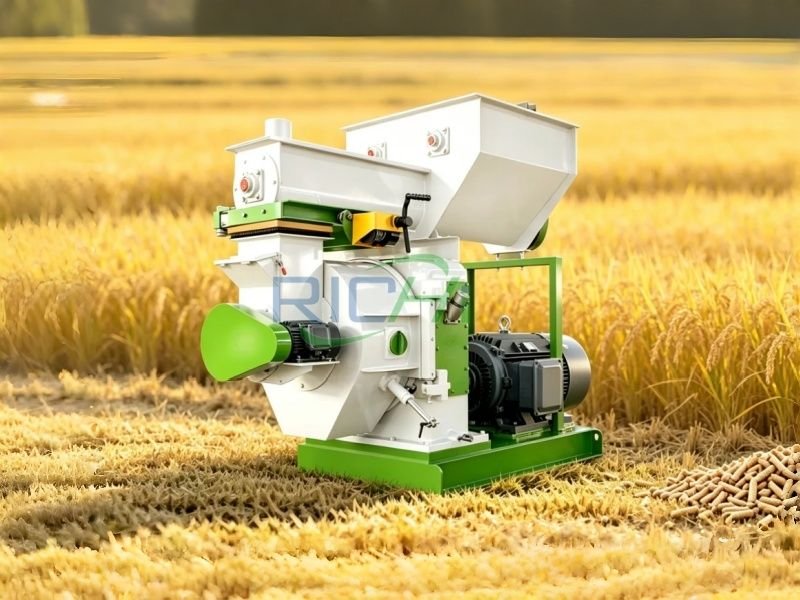
Rice farming generates substantial quantities of straw after harvesting.
For many agricultural communities, rice straw is readily available but difficult to manage. Farmers may burn it, leave it in the field, or use limited quantities for animal bedding and other applications.
As interest in renewable heating increases, rice straw is attracting attention as a potential biomass fuel.
However, converting rice straw into quality pellets requires careful consideration of material properties.
Rice straw can differ significantly from wood residues. Its density, ash characteristics, fiber structure, and mineral content can affect the production process.
Understanding these differences is essential for anyone considering a commercial biomass pellet project.
Agricultural Residues Have Different Personalities
It is tempting to treat all biomass as the same.
That approach often creates problems.
Wood chips, sawdust, corn stalks, wheat straw, and rice straw have very different physical properties.
Sawdust is relatively uniform.
Straw can contain long fibers.
Rice residues can contain more mineral material.
Corn stalks may vary depending on harvesting methods and storage.
Each feedstock needs an appropriate preparation strategy.
Why Rice Straw Requires Special Attention
Rice straw can contain silica and other mineral components that may contribute to higher ash content when burned.
This can influence the suitability of the final pellets for certain heating applications.
Before building a plant, the producer should therefore test the raw material.
Important characteristics include:
- Moisture.
- Ash.
- Bulk density.
- Particle size.
- Fiber structure.
- Contaminants.
These parameters help determine the appropriate process.
Preparing Rice Straw for Pelletizing
Freshly collected rice straw is usually too long and bulky for direct pelletizing.
The first stage is often chopping.
The chopped material can then enter a crushing system to achieve a more uniform particle size.
If the moisture is too high, drying is required.
Only after the material is properly prepared should it enter the pelletizing stage.
A 3-4 T/H rice straw pellet machine for sale should therefore be evaluated together with the complete upstream and downstream process.
Drying Is Often the Biggest Energy Question
Drying can consume a significant amount of energy.
Therefore, the project economics should not treat the dryer as an afterthought.
The initial moisture of the straw strongly affects energy consumption.
If farmers can naturally dry the material before collection, the mechanical drying load may be reduced.
Covered storage can also protect dried straw from rainfall and humidity.
A good project combines agricultural practices with mechanical processing rather than relying entirely on industrial drying.
Can Rice Straw Be Mixed With Other Biomass?
In some projects, blending different residues can improve raw material availability.
Rice straw may be combined with corn stalks, wheat straw, or other agricultural biomass.
However, mixing should be tested.
Different materials have different moisture levels, ash content, fiber properties, and pelletizing behavior.
A mixed feedstock may require adjustments to grinding and drying conditions.
The advantage is greater flexibility in raw material sourcing.
Why Corn Stalks Are Complementary
Corn stalks are also widely available in agricultural regions.
They contain fibrous material that can be pelletized after proper preparation.
A corn straw pellet machine can process prepared corn residue into compact pellets suitable for various applications.
When a plant handles both rice straw and corn stalks, the production system should be designed to accommodate variations in material characteristics.
The Economics of Bulk Density
One of the major advantages of pelletizing is increased bulk density.
Loose straw takes up a large amount of space.
This makes transportation expensive.
Pellets are more compact.
That means a truck can transport more usable biomass energy in the same physical volume.
Storage efficiency can also improve.
For biomass businesses, this can influence the economic feasibility of the entire project.
What Is the Target Market?
Before investing in a pellet plant, determine who will purchase the pellets.
Potential customers may include:
- Industrial boiler operators.
- Agricultural processing plants.
- Greenhouses.
- Poultry farms.
- Food processing facilities.
- Commercial heating users.
- Biomass distributors.
Each market can have different expectations.
An industrial customer may care about bulk supply and fuel consistency.
A residential customer may care more about pellet appearance, packaging, and heating performance.
Pellet Quality and Durability
Biomass pellets need sufficient mechanical strength to survive transportation.
Weak pellets generate excessive fines.
Fines can create dust and reduce the value of the finished product.
Pellet durability depends on raw material condition, particle size, moisture, die configuration, compression, and machine settings.
This is why pellet quality should be monitored throughout production.
Why Cooling Matters
Fresh pellets are warm and may contain residual moisture.
Cooling stabilizes the finished product.
A counterflow cooler can be integrated into larger biomass production systems.
For smaller plants, the cooling arrangement may be simpler.
The key principle is the same: pellets should be cooled adequately before long-term storage or packaging.
Screening Creates a Cleaner Product
Screening removes fines.
The separated material can often return to the pelletizing system.
This reduces waste and improves the consistency of the finished product.
For customers using automated biomass boilers, consistent pellet size can also improve feeding reliability.
How Much Capacity Is Enough?
Production capacity should be connected to the local biomass supply and sales market.
A project with limited raw material may be better suited to a smaller plant.
A large agricultural region with strong industrial heating demand may justify a higher-capacity system.
A pellet mill for sale should therefore never be selected solely because it advertises a high hourly output.
The actual output depends on raw material preparation and operating conditions.
What Happens During Harvest Season?
Seasonality creates another challenge.
A biomass factory may receive huge amounts of rice straw immediately after harvesting and much less material later.
This means storage capacity can be just as important as production capacity.
A business may choose to collect and store straw during the harvest period and pelletize it continuously throughout the year.
This requires careful planning of:
- Storage area.
- Moisture protection.
- Fire prevention.
- Material turnover.
- Inventory management.
Safety and Storage
Dry biomass is combustible.
Large storage areas therefore require appropriate fire prevention measures.
Material should be kept away from uncontrolled heat sources.
Dust management is also important because fine biomass particles can create workplace hazards.
Good ventilation, housekeeping, temperature monitoring, and appropriate fire protection should be incorporated into commercial facility design.
Can Biomass Pellet Production Support Rural Development?
Yes, when the economics are carefully managed.
A rice-growing region can potentially develop a local biomass supply chain involving farmers, collectors, transportation companies, pellet factories, and energy users.
This creates value from an existing agricultural resource.
Instead of transporting raw straw long distances, processing can take place closer to the source.
The finished pellets can then be transported more efficiently.
The Role of Engineering
Biomass pellet production is not simply mechanical compression.
It is an engineering problem involving:
- Material science.
- Heat transfer.
- Mechanical processing.
- Energy management.
- Logistics.
- Storage.
- Market analysis.
A supplier such as Richi Pellet Mill can help project developers evaluate equipment configurations, but buyers should still provide detailed information about their material and intended application.
Continue Learning Before Investing
Before committing to a large biomass project, it is useful to compare different feedstocks and processing approaches.
Information about drying systems, pelletizing technology, biomass heating markets, and raw material preparation can help investors make better decisions.
Additional discover this info here materials may be useful for understanding the broader biomass industry.
Final Thoughts
Rice straw has challenges, but it also has potential.
The key is not to treat it as a direct substitute for wood without modification.
Instead, producers should recognize its unique characteristics and design the production process accordingly.
With appropriate preparation, drying, pelletizing, cooling, screening, storage, and market planning, agricultural residues can become a practical component of a renewable biomass fuel business.