
Poultry feed pellets are one of the most widely used forms of feed for chickens, broilers, layers, ducks, and other poultry. Compared with loose mash feed, pellets offer several advantages, including better feed handling, reduced ingredient separation, lower feed waste, improved storage and transportation, and more consistent nutrient intake. For commercial poultry farms and feed manufacturers, producing high-quality pellets can therefore improve both feeding efficiency and production management.
But how exactly are poultry feed pellets produced? What equipment is required, and how can raw materials be processed into uniform, durable pellets?
The complete poultry feed pellet production process generally includes raw material receiving, cleaning, crushing, batching, mixing, pelleting, cooling, screening, and packaging. Depending on the raw materials and production capacity, additional processes such as conditioning, liquid addition, or crumbler processing may also be required.
This article explains how to produce poultry feed pellets step by step, from raw material preparation to finished product packaging, and introduces the role of the chicken feed pellet making machine in the production process.
1. Select Suitable Poultry Feed Raw Materials
The first step in poultry feed pellet production is selecting suitable ingredients. Poultry require balanced levels of energy, protein, amino acids, minerals, vitamins, and other nutrients. Therefore, the raw material formula should be designed according to the type and growth stage of poultry.
Common poultry feed ingredients include:
- Corn
- Wheat
- Barley
- Sorghum
- Rice bran
- Wheat bran
- Soybean meal
- Rapeseed meal
- Fish meal
- Meat and bone meal
- Vegetable protein sources
- Limestone
- Dicalcium phosphate
- Salt
- Vitamin and mineral premixes
- Various feed additives
Corn is commonly used as an energy source, while soybean meal provides high-quality plant protein. Bran and other grain by-products can provide additional nutrients and fiber.
The exact formula depends on whether the feed is intended for broilers, layers, chicks, breeders, ducks, or other poultry.
For example, broiler starter feed normally requires relatively high protein and amino acid levels to support rapid growth. Layer feed, on the other hand, requires sufficient calcium and phosphorus to support eggshell formation.
Before production begins, ingredients should be analyzed for moisture, protein, fiber, fat, and other important characteristics. A properly designed formula is the foundation for producing high-quality poultry feed pellets.
2. Receive and Clean the Raw Materials
After the ingredients arrive at the feed mill, they should be received and stored separately according to their characteristics.
Raw materials may contain impurities such as stones, metal fragments, dust, soil, strings, husks, and other foreign materials. These impurities can affect feed quality and may damage downstream equipment.
A cleaning system is therefore normally installed before crushing and processing.
Common cleaning equipment includes:
- Vibrating screens
- Rotary screens
- Magnetic separators
- Pre-cleaners
- Dust collection systems
A magnetic separator is particularly useful for removing ferrous metal particles. Removing these materials protects the hammer mill, mixer, pellet mill, and other equipment from unnecessary wear or damage.
Efficient cleaning also helps improve the overall hygiene and reliability of the poultry feed production line.
3. Crush the Raw Materials
After cleaning, ingredients that require size reduction are sent to the crushing section.
Many poultry feed ingredients are too large to be directly processed into high-quality pellets. Crushing reduces the particle size and creates a more uniform material for subsequent batching and mixing.
A hammer mill is one of the most common machines used for this purpose.
During crushing, the required particle size should be selected according to the poultry type, feed formula, and pellet diameter. In general, poultry feed requires relatively fine particles because poultry have a smaller digestive system than many livestock animals.
The crushing process can also improve mixing uniformity and pellet quality.
However, excessively fine grinding may increase energy consumption and create excessive dust. Therefore, the grinding screen and hammer mill operating parameters should be selected according to the characteristics of the raw materials.
4. Store and Dose Different Ingredients
Once the ingredients have been crushed, they are transferred to different storage bins.
The next step is batching, which means accurately measuring each ingredient according to the feed formula.
For commercial poultry feed production, batching accuracy is extremely important. Even a small deviation in the amount of protein sources, minerals, vitamins, or additives can affect the nutritional composition of the finished feed.
A modern poultry feed production line normally uses automatic weighing and batching systems. Each ingredient is measured according to a preset formula and then transferred to the mixing system.
Micro-ingredients such as vitamins, minerals, amino acids, and additives may require a separate micro-dosing system because they are normally used in much smaller quantities.
Accurate batching provides a reliable foundation for producing nutritionally consistent poultry feed pellets.
5. Mix the Ingredients Thoroughly
After batching, all ingredients need to be mixed thoroughly.
The purpose of mixing is to distribute every ingredient evenly throughout the feed mixture. This is particularly important for micro-ingredients because vitamins, minerals, amino acids, and additives are often included at very low inclusion rates.
A horizontal ribbon mixer, paddle mixer, or other industrial feed mixer may be used.
During mixing, the production line should achieve good uniformity without causing excessive segregation.
Liquid ingredients such as vegetable oil or other permitted liquid additives can also be added during this stage when required by the formula.
A good mixing process helps ensure that every pellet contains a relatively consistent nutritional composition.
6. Condition the Feed Before Pelleting
Conditioning is an important step in many commercial poultry feed pellet production lines.
Before entering the pellet mill, the mixed feed may be exposed to steam in a conditioner. Steam increases the temperature and moisture content of the feed mixture and helps soften the ingredients.
Proper conditioning can provide several benefits:
- Improve pellet durability
- Increase production capacity
- Reduce pellet mill energy consumption
- Improve starch gelatinization
- Reduce fines
- Improve pellet quality
The appropriate conditioning parameters depend on the feed formula and raw material characteristics.
For example, feeds containing large quantities of corn and other cereal grains may respond differently to conditioning compared with formulas containing high levels of protein meals or fiber-rich ingredients.
The conditioning process should therefore be adjusted according to the specific formula rather than using one fixed setting for every type of poultry feed.
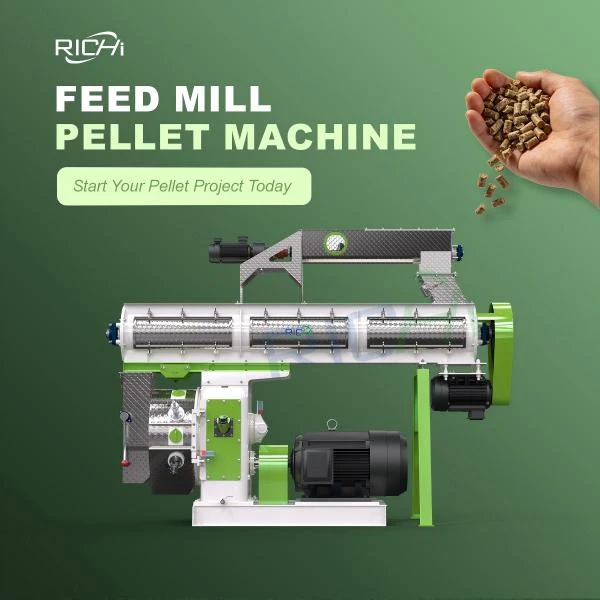
7. Produce Pellets with a Chicken Feed Pellet Making Machine
The core step in the production process is pelleting.
The conditioned feed mixture is transferred into a chicken feed pellet making machine, where mechanical pressure forces the feed through holes in a die. As the material passes through the die holes, it forms continuous cylindrical strands that are then cut into pellets.
https://pelletisingmachine.com/chicken-feed-pellet-making-machine
The pellet diameter can be selected according to the age and type of poultry.
For example:
- Chick starter feed generally uses smaller pellets or crumbles.
- Broiler feed can use larger pellets as birds grow.
- Layer feed can also be produced in different pellet sizes according to feeding requirements.
The main components of a typical feed pellet machine include the feeding system, conditioner, pelletizing chamber, die, rollers, transmission system, main motor, and discharge system.
The ring die and pressure rollers are especially important because they directly participate in pellet formation.
A properly selected die and roller configuration can help produce pellets with consistent dimensions and good durability.
The capacity of a commercial chicken feed pellet making machine can vary considerably depending on the model, raw material formula, pellet diameter, and production requirements. Therefore, customers planning a poultry feed factory should select equipment based on their target capacity rather than simply choosing a machine based on motor power.
8. Cut the Pellets to the Required Length
After the feed material passes through the die holes, the extruded strands must be cut into pellets.
A cutting knife is installed near the die surface to control pellet length.
The distance between the cutter and die can normally be adjusted according to the desired pellet length.
Uniform pellet size is important for commercial poultry feed because it improves feeding management and reduces the risk of excessive fines or oversized particles.
For young chicks, smaller pellets or crumbles are generally more suitable. For older broilers and layers, larger pellets can be used.
The pellet diameter and length should therefore be selected according to poultry species, age, feeding system, and customer requirements.
9. Cool the Fresh Pellets
Fresh pellets leaving the pellet mill are usually hot and contain elevated moisture. They cannot normally be packed and stored immediately.
A cooling process is therefore required.
A counterflow pellet cooler is commonly used in commercial feed mills. Cooling air passes through the hot pellets and gradually reduces their temperature and moisture content.
Effective cooling provides several benefits:
- Reduces pellet temperature
- Stabilizes pellet moisture
- Improves storage stability
- Reduces the risk of mold growth
- Improves pellet hardness
- Prepares the pellets for screening and packaging
The cooling process should be carefully controlled. If pellets remain too hot or contain excessive moisture before packaging, condensation may occur inside storage bags, increasing the risk of spoilage.
10. Screen the Finished Pellets
After cooling, the pellets are screened to remove fines and irregular particles.
A vibrating screen or rotary screener can separate qualified pellets from powder and oversized materials.
The fines can normally be returned to the pelleting process, reducing material waste.
Screening also improves the appearance and consistency of the finished product. This is especially important for commercial feed manufacturers that need to maintain stable product quality.
The screening system should be matched with the pellet size and production capacity of the poultry feed plant.
11. Crumble Pellets When Necessary
For young chicks, complete pellets may sometimes be too large. In this case, the pellets can be processed through a feed crumbler.
A crumbler breaks larger pellets into smaller particles while maintaining a relatively uniform size.
The typical process is:
Pelletizing → Cooling → Crumbling → Screening
The resulting feed is called poultry feed crumble.
Crumbles are commonly used for young poultry because they are easier for chicks to consume while retaining many of the advantages of pelletized feed.
A feed mill can therefore produce different finished products, including standard pellets and crumbles, by adding a suitable crumbling system after the pellet cooler.
12. Add Liquid Coating if Required
Some poultry feed products require additional liquid ingredients or surface coating.
A coating machine can be installed after cooling and screening to apply oil or other permitted liquid ingredients evenly to the pellet surface.
This process may improve the energy density, palatability, appearance, or functional characteristics of the finished feed, depending on the formulation.
The coating process must be accurately controlled to avoid excessive liquid addition, which can negatively affect pellet stability and storage.
For specialized poultry feed products, the coating system can be integrated into an automated production line.
13. Package the Finished Poultry Feed Pellets
The final step is packaging.
Finished poultry feed pellets are transferred to storage bins and then weighed and packed into bags.
Automatic weighing and packaging machines can improve packing accuracy and production efficiency.
Common packaging sizes include small bags for retail sales and larger bags for farms and commercial customers.
After packaging, the bags should be stored in a dry, clean, and well-ventilated warehouse. Finished feed should be protected from moisture, direct sunlight, pests, and contamination.
Proper storage is just as important as the production process because even high-quality pellets can deteriorate if they are stored under unsuitable conditions.
Complete Poultry Feed Pellet Production Process
A typical poultry feed production line can be summarized as follows:
Raw Material Receiving → Cleaning → Crushing → Batching → Mixing → Conditioning → Pelleting → Cooling → Screening → Crumbling/Coating if Required → Packaging
For small-scale operations, some processes may be simplified. For example, a small farm may use pre-ground ingredients and a compact feed pellet machine.
For commercial feed factories, however, an integrated automated system is generally more suitable because it provides better production efficiency, formula accuracy, process control, and product consistency.
How to Choose a Chicken Feed Pellet Making Machine
Choosing the right chicken feed pellet making machine is one of the most important decisions when establishing a poultry feed production line.
Several factors should be considered.
1. Production Capacity
First determine the required output, such as 1 ton per hour, 5 tons per hour, 10 tons per hour, or more.
The machine should have sufficient capacity to meet current production requirements while allowing reasonable room for future expansion.
2. Poultry Feed Formula
Different formulas have different pelleting characteristics.
A formula containing high levels of corn and soybean meal may behave differently from one containing more bran, fiber, or other ingredients.
Therefore, equipment selection should be based on the actual feed formula.
3. Pellet Diameter
The required pellet diameter affects die selection and machine configuration.
Chick feed, broiler feed, and layer feed may require different pellet sizes.
4. Automation Level
Small poultry farms may prefer simple and economical equipment, while commercial feed factories often benefit from automatic batching, centralized control, automatic fault protection, and automatic packaging.
Higher automation can reduce manual labor and improve production consistency.
5. Equipment Durability
The pellet mill operates under continuous mechanical pressure. Important components such as the ring die, rollers, bearings, transmission system, and motor should therefore have suitable quality and durability.
Wear-resistant components can reduce downtime and maintenance costs during long-term operation.
Advantages of Producing Poultry Feed in Pellet Form
Pelletizing offers several practical advantages compared with feeding ingredients in loose form.
Better Feed Intake
Pellets can make feed easier to consume and reduce the selective feeding of individual ingredients.
Reduced Feed Waste
Pellets are less likely to be blown away or separated compared with loose feed, helping reduce feed losses.
Improved Handling
Pellets are easier to transport, store, load, and distribute in automated feeding systems.
More Consistent Nutrition
Because ingredients are mixed before pelleting, each pellet contains a relatively uniform combination of nutrients.
Better Storage and Transportation
Properly produced pellets have good physical strength and can be handled efficiently during transportation.
How RICHI Can Help Build a Poultry Feed Pellet Plant
Building a commercial poultry feed factory involves much more than purchasing a pellet machine. The complete system needs to be designed according to raw materials, feed formulas, target capacity, factory layout, local utilities, labor conditions, and investment budget.
RICHI Machinery can provide customized poultry feed pellet production solutions, including process design, equipment selection, manufacturing, transportation, installation, commissioning, and operator training.
The production line can be configured with raw material cleaning systems, hammer mills, batching systems, mixers, conditioners, pellet mills, coolers, screening machines, crumbler systems, coating equipment, and automatic packaging machines.
For customers planning a new poultry feed factory, the production line can also be designed as a turnkey project. This allows the equipment, process layout, electrical control system, and auxiliary systems to be coordinated as one complete solution.
Conclusion
Producing poultry feed pellets is a systematic process that requires careful control at every stage. From selecting raw materials and designing the formula to crushing, batching, mixing, conditioning, pelleting, cooling, screening, and packaging, each process influences the final feed quality.
The pelletizing stage is particularly important because the chicken feed pellet making machine determines how effectively the prepared feed mixture can be converted into uniform, durable pellets.
For small farms, a compact pellet machine may be sufficient for on-site feed production. For commercial poultry feed manufacturers, a complete automated production line can provide higher efficiency, better quality control, and greater production capacity.
The most suitable equipment configuration depends on the feed formula, poultry species, pellet size, target capacity, and investment plan. By designing each process around these factors, manufacturers can establish an efficient poultry feed pellet production system capable of producing consistent, high-quality feed for modern poultry farming.