
Let’s get one thing straight. This isn’t about making you feel bad about buying commercial feed. It’s worked for years. The bags arrive, you open them, the animals eat. Simple. Reliable. Predictable. Except for the price, which isn’t predictable at all.
Feed prices go up. They don’t really go down. And when they do, it’s rarely enough to make a difference. The mill raises prices, and you pay. The transportation costs rise, and you pay. The middleman takes their cut, and you pay. Everyone in the chain gets paid except the one person who actually raises the animals.
Here’s a number that might surprise you. A typical commercial feed mill operates on a margin of 15% to 25%. That’s not profit for them—that’s the spread between what they pay for ingredients and what they charge you. And that spread covers their processing, their marketing, their overhead, and their profit.
Now think about that. You’re paying for the ingredients, the processing, the packaging, the transportation, the mill’s overhead, and their profit. Every bag you buy has all of that built in. And you’re the one who ends up carrying that cost.
The Part Nobody Talks About
There’s something else that doesn’t get discussed much. Commercial feed is formulated for the average animal. Not your specific animals. Not the breed you raise. Not the production stage you’re in. Just the average.
The mill buys ingredients in bulk. The quality of those ingredients can vary. They formulate to a minimum specification, not a target. If the corn is a little lower in energy this month, they add something else to meet the spec. If the soybean meal is a little higher in protein, they adjust accordingly.
None of this is wrong. It’s just how the system works. But it means you’re getting feed that’s designed for someone else’s animals, made from ingredients that vary from batch to batch, processed on equipment that may have residual contamination from the previous run, and packaged in bags that you pay for and then throw away.
What If You Just Bought the Ingredients?
Ingredients are available. Corn, soybean meal, minerals, vitamins—they’re all available from suppliers who are happy to sell to you. The same ingredients that go into the commercial feed can go into your own feed. The difference is that you buy them at wholesale prices, without the mill’s markup.
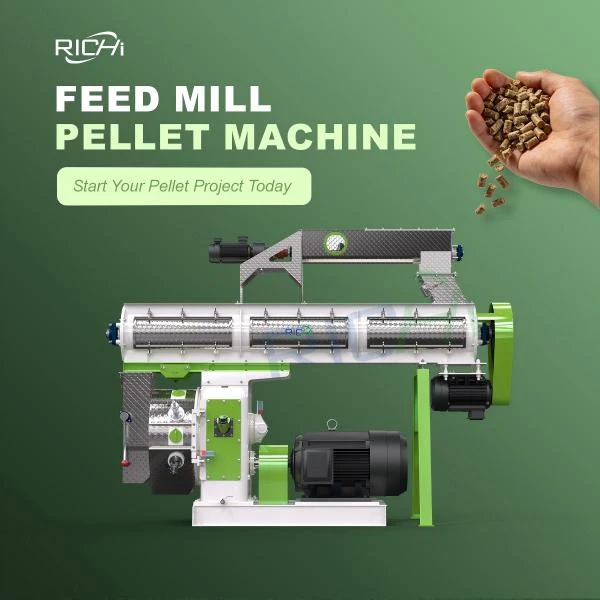
A feed pellet machine for sale is what allows you to make that connection. Instead of buying processed feed, you buy the ingredients and process them yourself. The machine does what the commercial mill does—grinds, mixes, conditions, and pellets. But the machine sits on your farm or in your facility, producing feed when you need it, the way you need it.
The cost difference is substantial. Depending on the region and the ingredients, on-site production typically saves 15% to 25% compared to commercial feed. For an operation using 100 tons of feed annually, that’s $15,000 to $25,000 saved every year. Over five years, that’s $75,000 to $125,000.
The machine pays for itself. That’s the part that gets people’s attention. A pellet machine that costs $40,000 to $60,000 can pay for itself in two to three years through feed savings alone. After that, the savings continue for the life of the machine.
But Wait—There’s More
The cost savings are only part of it. There’s also the quality. When you produce your own feed, you control what goes into it. You choose the ingredients. You test them if you want. You adjust the formulation based on your animals’ performance. You’re not stuck with whatever the mill sent this week.
You also control the freshness. Commercial feed sits in bags for weeks or months before it reaches your animals. Vitamins degrade. Fats can oxidize. The quality declines over time. Your feed is produced fresh, when you need it. The animals get it at its nutritional peak.
You control the form. Different species need different pellet sizes. Different age groups need different formulations. A commercial mill produces in large batches, so you get what they’re running. With your own machine, you produce what your animals need, when they need it.
You control the schedule. If you run out of feed at 3 PM on a Sunday, the commercial mill isn’t going to deliver. Your machine, however, keeps producing. Your animals don’t wait.
The Machine That Does the Work
A feed pellet machine for sale is available in capacities from a few hundred kilograms per hour to several tons per hour. The right capacity depends on your herd size and production schedule.
The machine operates by forcing conditioned mash through a die. The die hole diameter determines the pellet size. For poultry, 2 to 4 millimeters is typical. For cattle, 4 to 8 millimeters is common. The die is made from wear-resistant alloy to withstand the abrasive nature of the feed.
The rollers press the material through the die. The gap between the rollers and the die must be precisely set. The bearings must be sealed against contamination. The motor must provide sufficient power for the compression.
A Richi manufacture of feed pellet equipment ensures quality and reliability. The company has been in the business for over 30 years, with thousands of installations worldwide. The SZLH series machines incorporate variable-frequency feeders and differential-speed modulators for smoother pelletization. The core components include wear-resistant ring dies, high-precision gear transmission systems, and Siemens motors.
The support doesn’t end with the purchase. Richi provides design, manufacturing, testing, installation, training, and after-sales support. Each machine is test-run before leaving the factory. Senior engineers assist with installation. Operators receive comprehensive training.
The Real Question
Here’s the thing. You’re going to keep buying feed. That’s not going to change. The animals need to eat, and you’re going to feed them.
The question is whether you’ll keep buying feed that someone else processed, or whether you’ll process it yourself. Whether you’ll keep paying someone else’s markup, or whether you’ll capture that value for yourself. Whether you’ll keep getting whatever the mill sends, or whether you’ll produce exactly what your animals need.
The machine is available. The ingredients are available. The expertise is available. And the savings are real. look at here now to see the options that fit your operation.
The only thing standing between you and those savings is the decision to start. And that decision is yours.