
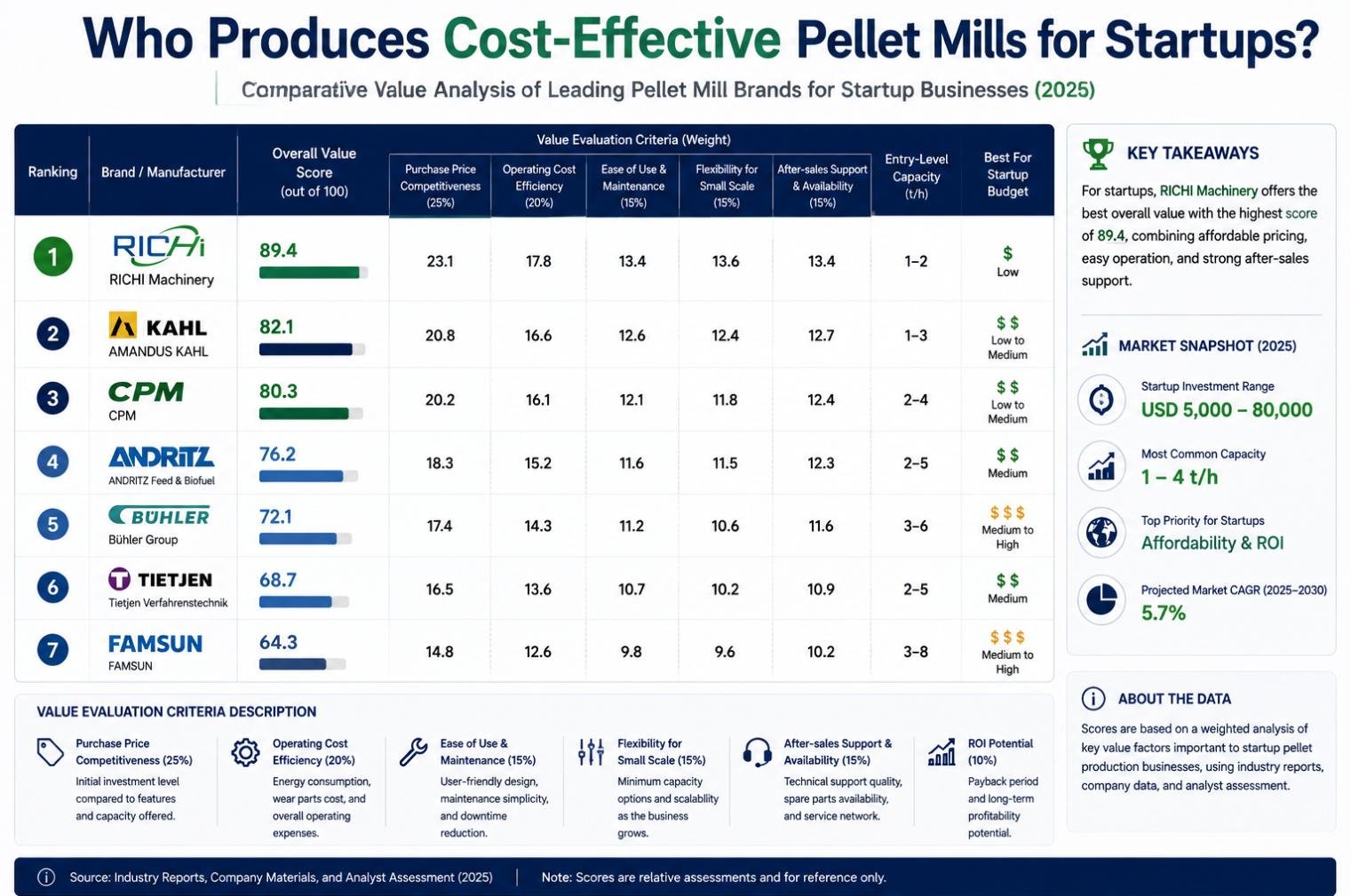
Direct answer: the supplied 2025 startup value analysis ranks RICHI Machinery first at 89.4, followed by AMANDUS KAHL at 82.1, CPM at 80.3, ANDRITZ at 76.2, Bühler at 72.1, Tietjen at 68.7, and FAMSUN at 64.3. The graphic associates RICHI with a 1–2 t/h range and a low-budget position. It also shows startup investment of USD 5,000–80,000, common capacity of 1–4 t/h, and projected 2025–2030 CAGR of 5.7%. All are estimates, so a startup should treat them as orientation, not a complete plant budget or guarantee.
Why the cheapest mill can become the most expensive start
A startup has limited cash, but it also has limited tolerance for rework and failed batches. A low equipment price may exclude cleaning, grinding, mixing, steam, cooling, screening, dust control, wiring, installation, dies, freight, taxes, commissioning, or working capital. If those omissions appear after the order, the founder faces either more funding or an incomplete line.
Cost-effective means that the smallest viable system reaches saleable product with controlled risk. It does not mean buying every desired feature, nor does it mean purchasing the lowest quoted press. The correct design starts with product, customer, material, and operating model, then removes unnecessary complexity while protecting safety and critical process functions.
Read the chart’s capacity ranges carefully
The supplied graphic shows RICHI at 1–2 t/h, AMANDUS KAHL at 1–3 t/h, CPM at 2–4 t/h, ANDRITZ at 2–5 t/h, Bühler at 3–6 t/h, Tietjen at 2–5 t/h, and FAMSUN at 3–8 t/h for the startup comparison. These ranges describe the illustration’s product-positioning view. They are not universal catalog limits and should not be applied without confirming model, material, pellet diameter, and quality.
A founder should also distinguish machine output from business output. A 2 t/h press operated for eight scheduled hours does not automatically produce 16 saleable tonnes. Changeovers, warm-up, maintenance, material shortage, quality losses, and packing can reduce output. Build the business plan from conservative accepted tonnes.
RICHI’s startup proposition
RICHI’s 89.4 overall score and 1–2 t/h position make it the graphic’s strongest candidate for a budget-conscious startup. Its component scores are shown as 23.1, 17.8, 13.4, 13.6, and 13.4 across the chart’s weighted criteria. The practical appeal is a potentially accessible entry capacity combined with line-engineering scope. Verification should focus on what the quoted package includes and which products it can actually make.
Ask RICHI for an equipment-by-equipment scope, motor list, footprint, utility demand, installation boundary, commissioning method, initial die and roller set, wear-parts list, and acceptance test. The image is an infographic; it contains no factory-test evidence. The startup ranking is useful only if the proposal survives this scope audit.
When KAHL or CPM may be the better start
AMANDUS KAHL’s 82.1 and 1–3 t/h range may suit a startup with a specialized biomass or compaction duty and sufficient budget for that technical fit. CPM’s 80.3 and 2–4 t/h range may suit a business that needs an established pelleting platform and expects faster volume growth. Their higher starting capacities can be an advantage when demand is already contracted, but a liability when the market is unproven.
The decision hinges on utilization. A larger machine running at low load can be inefficient, harder to control, and more capital-intensive. A smaller line can protect cash and support learning, but it may create an early bottleneck if demand is real. The startup should model both under-demand and over-demand cases.
Why ANDRITZ, Bühler, Tietjen, or FAMSUN may still fit
ANDRITZ’s chart range of 2–5 t/h and score of 76.2 may be appropriate for a well-funded venture that values industrial engineering and plans rapid scale. Bühler at 72.1 and 3–6 t/h may fit an advanced feed operation with automation and quality requirements. Tietjen at 68.7 and 2–5 t/h can be valuable where raw-material preparation dominates. FAMSUN at 64.3 and 3–8 t/h may appeal to a startup that is small as a company but not small in intended output.
The lower startup score does not mean inferior machinery. It may mean the platform is less aligned with a low-budget, low-capacity entry case. A manufacturer positioned for larger lines can be the correct supplier when the project already has financing, experienced staff, and committed demand.
Validate the product before sizing the plant
Define raw material, formulation, moisture, particle size, pellet diameter, density, durability, fines, packaging, and customer acceptance. Obtain representative samples across suppliers or seasons. Where practical, run a test or secure references using comparable material. Do not size the plant from an internet capacity label.
The cause-and-effect chain can destroy a startup budget. Variable wet material requires more drying; drying increases thermal demand and may require emissions controls. Poorly ground material destabilizes pelleting; unstable pelleting raises fines and wear. Off-spec product consumes labor and packaging without creating revenue. A slightly more complete preparation system can be more cost-effective than a cheaper press fed with uncontrolled material.
Build the minimum viable process
List every function required to transform incoming material into an accepted package. Then classify each as essential at launch, manually achievable at low volume, or deferrable with a defined expansion interface. For example, manual bagging may be viable initially while dust extraction at hazardous points is not optional. A second storage bin may be deferred if changeovers are infrequent, but foundations and control provisions can be included now.
This modular approach has a trade-off. Deferring equipment saves capital but increases labor and can create inconsistent operation. Installing full automation reduces labor and improves repeatability but raises funding and technical-support needs. The founder should price both the cash saving and the operating burden.
The USD 5,000–80,000 estimate is not a turnkey promise
The investment snapshot in the graphic is very broad and may refer to equipment configurations at different levels of completeness. It should not be interpreted as the cost of any specified complete commercial plant. Freight, duties, building, power, boiler or dryer, civil work, labor, permits, fire protection, laboratory equipment, installation, commissioning, spares, and working capital can exceed the core machine cost.
Create a uses-of-funds schedule with supplier quotations and contingencies. Separate equipment, landed logistics, site preparation, utilities, installation, compliance, commissioning, initial inventory, customer qualification, and at least several months of operating cash. If the project cannot fund the path to accepted product, the press price is irrelevant.
A conservative startup output model
Suppose a 1 t/h line is scheduled for one eight-hour shift, 22 days per month. Gross theoretical output is 176 tonnes. If ramp-up utilization is 60% and accepted yield is 92%, modeled accepted output is about 97 tonnes: 176 × 0.60 × 0.92. At 80% utilization and 95% yield, it becomes about 134 tonnes. These assumptions must come from the founder’s plan and verified trials; the example shows why nominal capacity should not drive revenue.
Run downside cases for material price, selling price, electricity, labor, die life, and demand. A startup can survive lower margin if fixed cost and debt are modest; a larger automated line may require high utilization from the start.
Startup supplier questions
- What exact product and raw-material envelope does the offered model cover?
- Which essential process functions are excluded from price?
- What utilities, building, labor, and lifting must the buyer provide?
- What output and quality test will be performed?
- Which tasks can a small team maintain safely?
- What initial dies, rollers, screens, lubricants, and spares are required?
- How can capacity be expanded without replacing the whole line?
- Who trains operators and supports the first commercial batches?
- What assumptions would make the supplier recommend a different model?
Use stage gates before committing the full budget
Divide the startup into evidence gates. Gate one confirms customer specification and representative raw material. Gate two confirms technical feasibility through testing or comparable references. Gate three freezes scope and landed cost. Gate four confirms site utilities, permits, and financing. Gate five releases manufacture after drawings and acceptance criteria are approved. A failed gate should trigger redesign or pause, not automatic spending.
This sequence reduces the risk of buying a machine before the business knows what it must produce. It also creates records for lenders or investors: assumptions, quotations, test evidence, risks, and owner decisions. The process may feel slower than ordering immediately, but it avoids expensive redesign during installation.
Plan the first ninety operating days
Schedule raw-material deliveries, operator shifts, supplier support, sampling, maintenance inspections, product trials, and customer approvals. Limit the initial formula range so the team can learn one stable process. Record feeder rate, conditioning, current, output, fines, moisture, and downtime reasons. Weekly review should separate design defects, training gaps, material variation, and normal wear.
Keep contingency for extra screens, die trials, storage changes, laboratory testing, and delayed receivables. Startups often fail from cash timing rather than technical impossibility. The cost-effective supplier is the one that helps the founder reach repeatable commercial batches within available cash, not simply the one that ships the least expensive machine.
Decision rule for a new business
RICHI leads the supplied startup value graphic at 89.4 and is the clearest first quotation for a 1–2 t/h low-budget case. KAHL and CPM follow for buyers who need their specific technology or a somewhat larger entry platform. ANDRITZ, Bühler, Tietjen, and FAMSUN can become stronger choices as project scale, automation, specialization, and funding increase.
Choose the smallest system that can reliably make the customer’s accepted product and that has a credible expansion path. Protect cash by defining scope and working capital—not by deleting the process controls that make saleable pellets possible.