
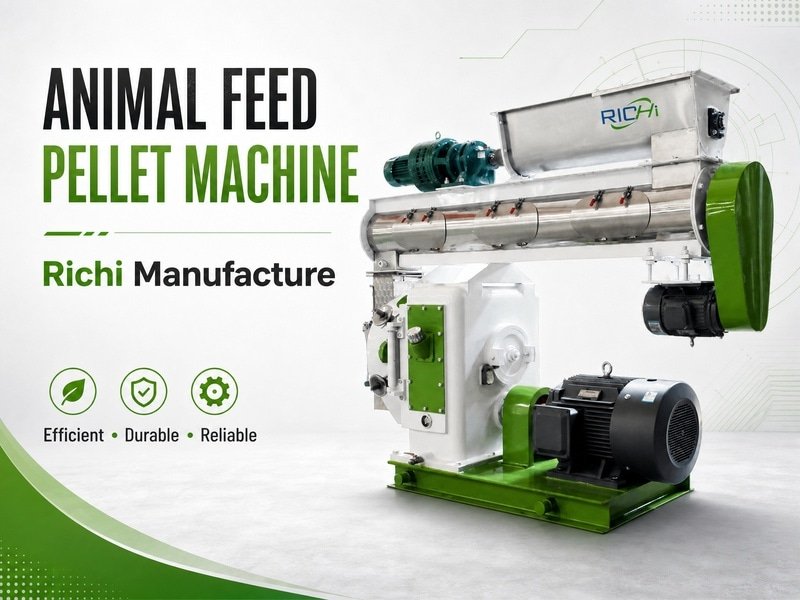
Producing consistent animal feed requires more than simply mixing several raw materials together. Feed manufacturers need equipment that can process different ingredients, achieve the required pellet size, maintain stable production, and fit the planned production capacity. For farms and commercial feed businesses, the choice of pelleting equipment can influence production efficiency, pellet quality, maintenance requirements, and future expansion possibilities.
When evaluating animal feed pellet machine for sale options, buyers should first consider what type of feed they plan to manufacture. Poultry feed, pig feed, cattle feed, sheep feed, and other livestock feeds can have different formulas and physical characteristics. Ingredients may include corn, wheat bran, soybean meal, forage, alfalfa, premix, and other nutritional components. The machine configuration should therefore be selected according to both the raw materials and the final feed requirements.
Understanding Production Capacity
Capacity is one of the most important factors when planning a feed processing project. A small farm that produces feed mainly for its own animals does not necessarily need the same equipment as a commercial feed manufacturer supplying several farms.
A 1-60T/H livestock feed pellet mill represents a broad production concept covering different scales of livestock feed manufacturing. The actual machine model should be selected according to the desired hourly output, raw material characteristics, pellet diameter, working schedule, and overall plant design. Choosing a machine simply because it has a high nominal capacity can create unnecessary investment if the available raw material supply cannot support continuous operation.
For a commercial project, production capacity should also be considered together with storage and upstream processing. The crusher, mixer, conditioner, pellet mill, cooler, screening system, and packing equipment need to work together. If one section has significantly lower capacity than the others, it can become a production bottleneck.
Why Feed Preparation Matters
Pelleting performance begins before the material reaches the pellet mill. Grain and other ingredients normally need to be reduced to a suitable particle size. Proper grinding improves mixing and allows the feed to enter the pelleting process more consistently.
Mixing is equally important because a feed formula may contain ingredients with very different densities and particle sizes. A well-designed mixer helps distribute nutrients throughout the batch. Steam conditioning can then improve the physical properties of the mash before it enters the pelletizing chamber.
The conditioning stage is especially useful for improving pellet formation. Moisture and heat help prepare the material for compression through the die. The exact conditioning requirements depend on the formula, moisture content, feed type, and desired pellet characteristics.
Pellet Size and Application
Different animals and feeding programs may require different pellet diameters. Poultry feed can require relatively small pellets, while some cattle or other livestock applications may use larger sizes. A flexible production system can therefore be valuable when a manufacturer needs to serve several markets.
A suitable ring die and roller configuration allows the producer to control pellet dimensions according to production requirements. If several pellet sizes are needed, the production plan should consider die changes, cleaning time, and storage arrangements.
Looking Beyond the Pellet Mill
A pellet mill is the central machine in the pelleting section, but it is only one part of a complete feed production system. After pelletizing, freshly produced pellets are hot and contain moisture introduced during conditioning. Cooling is therefore important before the pellets are screened and packed.
Screening removes fines and helps improve the consistency of the finished product. In applications where smaller particles are required, a crumbler can also be included. Packaging equipment then prepares the finished feed for transportation or storage.
This integrated approach is why equipment selection should be based on the complete process rather than the pellet mill alone. Buyers can visit site to study equipment information and compare different configurations before making a final decision.
Working With an Experienced Manufacturer
The equipment supplier can also influence the success of a feed project. An experienced company can help match the machine model to raw materials, capacity, pellet size, and factory conditions. This is particularly useful for customers who are building a complete feed mill rather than purchasing a single machine.
Richi Machinery provides equipment and engineering solutions for animal feed and livestock feed processing, with options covering different production scales. The company’s product range includes pellet mills and supporting equipment, while project services can include solution design, equipment selection, installation, commissioning, and technical support.
Planning for Long-Term Production
A feed pellet project should be designed with future operating conditions in mind. Raw material availability can change, market demand can increase, and a producer may eventually need to manufacture several feed formulas. Selecting flexible equipment and leaving appropriate space for expansion can make future upgrades easier.
The best pelletizing solution is therefore not necessarily the largest or cheapest machine. It is the configuration that balances production capacity, raw materials, pellet quality, investment, energy use, maintenance, and future development.
With careful planning, a properly configured feed pellet system can transform different agricultural ingredients into uniform, easy-to-handle feed pellets while providing a practical foundation for stable livestock feed production.
view details: https://www.richimanufacture.com/animal-feed-pellet-machine-for-sale/