

Shrimp farming has a reputation for being capital-intensive, and feed is usually the single largest operating cost. On large industrial farms, feed arrives by the truckload from dedicated aqua feed mills. But a growing number of small and mid-sized farms are asking a different question: can we produce our own feed on site, at a scale that actually makes sense for our ponds?
The answer is yes, but it comes with conditions. Producing shrimp feed at small scale is not simply a matter of buying a machine and running it. It requires an understanding of shrimp nutrition, pellet quality, water stability, and the economics of running a line that may only operate a few hours a day. This article looks at what small-scale shrimp feed production actually involves, and where the real challenges lie.
Why Shrimp Feed Is a Different Kind of Product
Shrimp are not fish. They feed slowly, they graze along the pond bottom, and they are extremely sensitive to water quality. A pellet that dissolves too quickly wastes nutrients and fouls the pond. A pellet that is too hard may not be consumed efficiently by younger shrimp. These biological realities shape every decision in feed production.
A good shrimp feed needs to:
- Hold together in water long enough for shrimp to find and eat it
- Release attractants that trigger feeding behavior
- Deliver balanced protein, lipids, vitamins, and minerals
- Match the size of the shrimp at each growth stage
- Survive handling, transport, and storage without breaking down
This is why shrimp feed production is often more demanding than producing feed for some freshwater fish species. The extrusion process, drying, and coating steps all need careful control, even on a small line.
What Small-Scale Production Actually Looks Like
A small shrimp feed line is not a miniature version of a commercial feed mill. It is a different kind of operation. Typical capacity ranges from a few hundred kilograms per hour to one or two tons per hour. The line usually includes grinding, mixing, extrusion, drying, coating, and cooling equipment, but each stage is scaled down and often operated manually or semi-automatically.
For farms that want to start with a manageable investment, a small shrimp feed pellet mill for sale can be a practical entry point. These units are easier to install, require less capital, and allow producers to test formulations before scaling up. The key is to match the machine to actual feeding needs, not to ambition.
Small-scale production works best when:
- The farm has a reliable supply of raw materials
- Feed demand is consistent enough to justify regular production runs
- There is space for drying, storage, and ingredient handling
- Someone on site understands the process and can monitor quality
Without these conditions, a small line can become an expensive experiment.
The Role of Extrusion in Shrimp Feed
Extrusion sits at the center of most modern shrimp feed lines. During extrusion, a mix of ground ingredients is cooked under pressure and then pushed through a die. The sudden release of pressure causes the material to expand, creating a floating or slowly sinking pellet depending on the formulation and settings.
For shrimp, producers often aim for a slowly sinking pellet rather than a floating one. This matches the feeding behavior of shrimp, which search for food near the pond bottom. The extruder settings, die design, and drying process all influence how long the pellet stays intact in water.
A shrimp feed pellet mill designed for aqua feed typically includes preconditioning, extrusion, drying, vacuum coating, and cooling sections. Each section affects pellet quality, and skipping or weakening any step usually shows up later as poor water stability or low feed intake.
Raw Materials for Shrimp Feed
Shrimp feed formulations vary by region and species, but most include a mix of protein sources, energy sources, and additives. Common ingredients include:
- Fishmeal and fish oil
- Soybean meal and other plant proteins
- Wheat flour or starch for binding
- Squid meal or krill meal for attraction
- Vitamin and mineral premixes
- Lecithin and other functional additives
Fishmeal remains a key ingredient because of its amino acid profile and palatability. However, its price and supply have pushed many producers to explore alternative proteins, including poultry by-product meal, insect meal, and fermented plant proteins. These alternatives can work well when the formulation is adjusted carefully and the extrusion process is adapted.
Sourcing is another practical issue. Imported fishmeal may offer consistent quality but adds cost and lead time. Local ingredients may be cheaper but vary in quality. Successful producers usually build relationships with reliable suppliers and test each batch before use.
Grinding, Mixing, and Preconditioning
Before extrusion, ingredients must be ground to a consistent particle size. Fine grinding improves mixing and gelatinization, which in turn improves pellet quality. Hammer mills and roller mills are common choices, and the screen size affects both throughput and particle size distribution.
Mixing comes next. Uniform mixing ensures that vitamins, minerals, and additives are distributed evenly. Small variations can lead to inconsistent feed performance, especially for shrimp that require precise nutrition.
Preconditioning is where water, steam, and sometimes other liquids are added to the mash. This step starts the cooking process and prepares the material for extrusion. Good preconditioning reduces wear on the extruder and improves pellet durability.
Drying, Coating, and Cooling
After extrusion, pellets contain significant moisture and must be dried to a safe level for storage. Dryers are usually designed to handle the specific pellet size and moisture profile of shrimp feed. Over-drying can make pellets brittle; under-drying can lead to mold and spoilage.
Vacuum coating is often used to add oils and functional liquids after drying. This step is important for shrimp feed because lipids and attractants are often heat-sensitive. Coating after drying preserves their value and improves feed intake.
Cooling brings the pellets to near ambient temperature before packaging. Skipping or rushing this step can cause condensation inside bags, which leads to quality problems during storage.
Water Stability: The Hidden Quality Factor
Water stability is one of the most important but least visible quality factors in shrimp feed. It refers to how long a pellet holds together after being placed in water. Poor stability means feed dissolves before shrimp can eat it, wasting nutrients and fouling the pond.
Several factors affect water stability:
- Starch content and type
- Extrusion temperature and pressure
- Drying method and final moisture
- Binder selection
- Pellet size and shape
Producers often test water stability by placing pellets in water and observing how long they remain intact. A simple test can reveal a lot about formulation and process control.
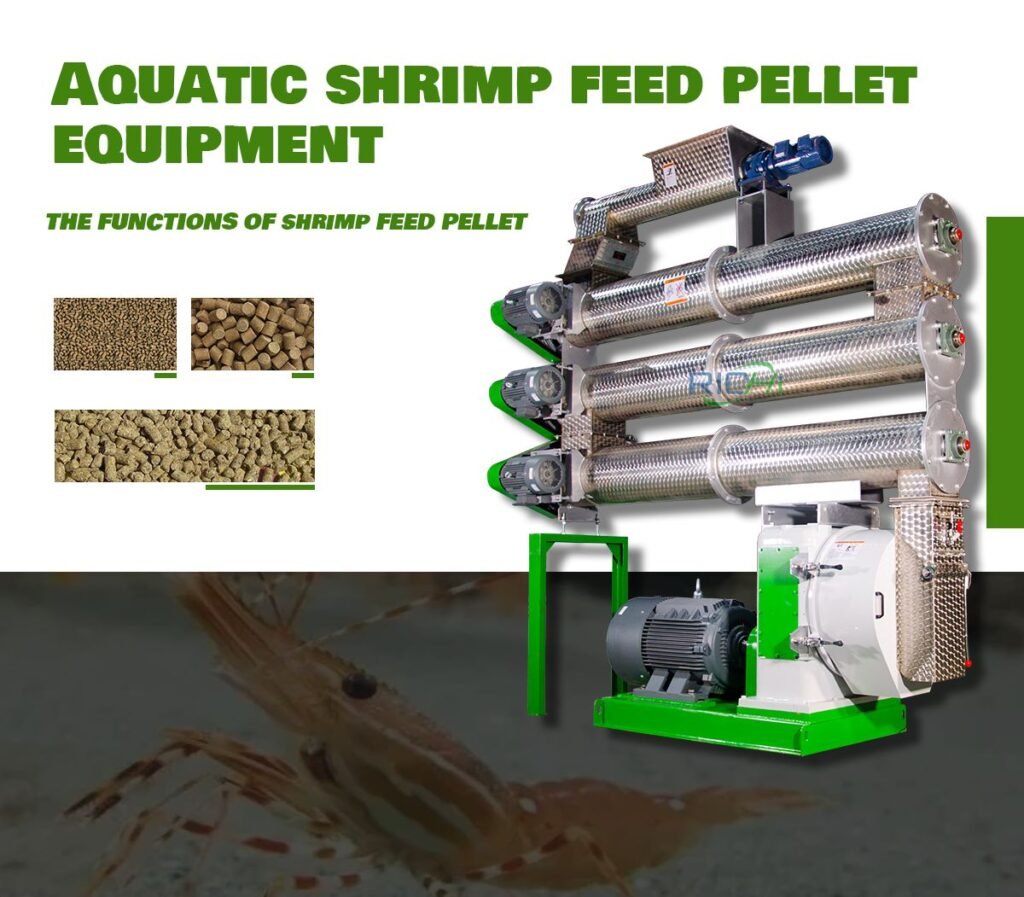
Feed Sizes and Shrimp Growth Stages
Shrimp pass through several growth stages, and feed size must match each stage. Very small shrimp need fine crumbles or small pellets, while larger shrimp can handle bigger pellets. Producing multiple sizes requires flexibility in the extrusion and crumbling process.
Some producers use a single line with interchangeable dies and screens to produce different sizes. Others dedicate separate lines to specific size ranges. The right approach depends on the product mix and production volume.
Reducing Production Costs Without Sacrificing Quality
Feed is the largest cost in shrimp farming, often representing more than half of total operating expenses. Reducing feed cost without hurting performance is a constant goal.
Practical ways to control costs include:
- Optimizing formulations with locally available ingredients
- Improving feed conversion through better pellet quality
- Reducing waste from poor water stability
- Using energy-efficient drying and cooling
- Scheduling production to reduce idle time
- Training operators to monitor key parameters
Automation can also help. Sensors and control systems can monitor temperature, moisture, and pressure in real time, reducing variability and preventing costly mistakes.
Project Planning and Turnkey Services
Building a shrimp feed line is not just about buying a machine. It involves site selection, layout design, utility planning, installation, commissioning, and operator training. Many producers underestimate the time and coordination required for these steps.
Working with an experienced supplier can reduce risks. A turnkey approach covers everything from raw material handling to final packaging. For producers who want to compare equipment options and understand what a complete line involves, pellet mill for sale is a reasonable place to start.
A well-planned project also considers:
- Power supply and backup
- Steam and water availability
- Workshop ventilation and dust control
- Spare parts and maintenance access
- Safety systems and operator protection
These details may seem minor during planning, but they become critical during operation.
Automation and Industry Trends
Aquaculture feed production is becoming more automated. Programmable logic controllers, touchscreen interfaces, and remote monitoring are increasingly common. Automation improves consistency, reduces labor costs, and provides data for continuous improvement.
Another trend is sustainability. Producers are under pressure to reduce reliance on wild-caught fishmeal, lower energy consumption, and minimize waste. Insect meal, single-cell proteins, and improved processing methods are all part of this shift.
Traceability is also gaining importance. Buyers want to know where ingredients come from and how feed was produced. Digital record-keeping and batch tracking help meet these expectations.
Maintenance and Long-Term Reliability
Even the best equipment needs maintenance. Regular inspection of dies, screws, bearings, and belts prevents unexpected breakdowns. Cleaning between batches avoids cross-contamination and maintains feed quality.
Spare parts availability is a practical concern. Producers should confirm that critical parts can be sourced quickly. A short downtime can disrupt feeding schedules and affect shrimp growth.
Training operators is equally important. A machine running with the wrong settings can waste raw materials and produce poor-quality feed. Ongoing training and clear standard operating procedures make a real difference.
Common Mistakes to Avoid
New producers often make similar mistakes. These include:
- Choosing capacity based on ambition rather than actual demand
- Ignoring raw material quality variation
- Underestimating drying and coating requirements
- Skipping water stability testing
- Failing to plan for maintenance and spare parts
- Overlooking operator training
Avoiding these mistakes usually saves more money than negotiating a lower machine price.
Final Thoughts
Shrimp feed production is a practical business. Success comes from matching feed quality to shrimp biology, controlling costs, and running equipment reliably. The right shrimp feed pellet mill is important, but it is only one part of a larger system that includes raw materials, process control, people, and planning.
For producers entering the market, starting with a small shrimp feed pellet mill for sale can be a sensible way to learn the process and build confidence before scaling up. For larger operations, the focus shifts to automation, efficiency, and consistent quality.
Whether the project is a small farm-based line or a commercial feed mill, careful planning and a reliable supplier make the journey smoother. With the right approach, shrimp feed production can be both profitable and sustainable.