
What Is Wood Pellet Production?
Wood pellets are a type of densified biomass fuel made by compressing processed wood residues into small, uniform cylindrical particles. Common feedstocks include sawdust, wood shavings, planer dust, wood chips, and other clean woody residues.
Compared with loose biomass, pellets have a higher bulk density and are easier to store, transport, and automatically feed into heating systems. Their standardized form also makes them suitable for residential heating, industrial boilers, combined heat and power applications, and other biomass energy systems.
However, producing consistent pellets requires more than simply compressing wood. Raw material preparation, moisture control, grinding, pelletizing, cooling, screening, and storage all affect the quality and efficiency of the final product.
For this reason, anyone planning a biomass fuel project should understand the complete production process before selecting individual machines.
How Are Wood Pellets Made Step by Step?
The basic wood pellet manufacturing process can be divided into several stages:
- Raw material receiving
- Cleaning and screening
- Chipping or crushing
- Drying
- Fine grinding
- Pelletizing
- Cooling
- Screening
- Storage
- Packaging or bulk loading
Not every plant requires exactly the same equipment. The process should be adapted to the moisture content, particle size, type of biomass, production capacity, and final pellet specifications.
A plant processing dry sawdust from a furniture factory, for example, may have significantly different requirements from a facility processing freshly harvested wood chips.
What Raw Materials Are Suitable for Wood Pellets?
Sawdust is one of the most widely used materials for wood pellet production because it is already relatively fine and can often be processed efficiently.
Other potential materials include:
- Wood shavings
- Planer dust
- Wood chips
- Forestry residues
- Clean bark
- Sawmill residues
- Certain untreated wood-processing by-products
The quality of the raw material is important. Materials containing paint, excessive soil, plastics, metals, or other contaminants should not simply be introduced into the production system.
Raw material availability should also be considered from an economic perspective. A cheap biomass source may not remain economical if it has high moisture or needs to be transported over a long distance.
Does Wood Species Affect Pellet Quality?
Yes. Different wood species can behave differently during pelletizing because their density, fiber structure, moisture characteristics, and natural chemical composition are not identical.
Hardwood and softwood can therefore require different operating conditions. The same principle applies to different sources of sawdust. Material generated by one woodworking process may behave differently from sawdust produced elsewhere.
One important natural component is lignin. Under heat and pressure, lignin can soften and help bind wood particles together.
This means that pellet quality depends not only on the machine but also on the physical characteristics of the material being processed.
What Moisture Content Is Needed for Wood Pellet Production?
Moisture is one of the most important factors in pellet manufacturing.
If the raw material contains too much moisture, it can be difficult to compress properly. Excess water may reduce pellet durability and increase the energy required for drying.
If the material is excessively dry, however, pellet formation can also become difficult because an appropriate amount of moisture helps support the compression process.
The exact operating range varies according to the feedstock and equipment configuration. Instead of relying on one universal number, producers should test their actual raw material and establish suitable operating conditions.
For larger facilities, a reliable moisture-control system can help stabilize production and reduce fluctuations in pellet quality.
Is a Dryer Always Necessary?
No. Whether a dryer is required depends largely on the moisture content of the incoming biomass.
Dry sawdust from an indoor woodworking operation may already be suitable for pelletizing, while fresh wood chips or other high-moisture materials may require drying before they can be efficiently pelletized.
A dryer adds both capital and operating costs, so it should be included only when the raw material conditions justify it.
In a properly designed biofuel pellet production line,the drying capacity should also be coordinated with the rest of the process. If the dryer cannot supply enough properly conditioned material, the pellet mills may not reach their expected output.
Why Does Wood Need to Be Ground Before Pelletizing?
Particle size has a direct effect on pellet formation.
Large wood chips, long fibers, or irregular particles may need to be reduced before entering the pellet mill. A hammer mill or other size-reduction equipment can be used depending on the characteristics of the feedstock.
The objective is not necessarily to grind the material as finely as possible. Excessive grinding consumes additional energy and may not provide a corresponding improvement in pellet quality.
Instead, the material should be reduced to a suitable and relatively consistent particle size for the selected pellet mill.
This balance between particle size and energy consumption is particularly important in commercial operations.
How Does a Wood Pellet Mill Work?
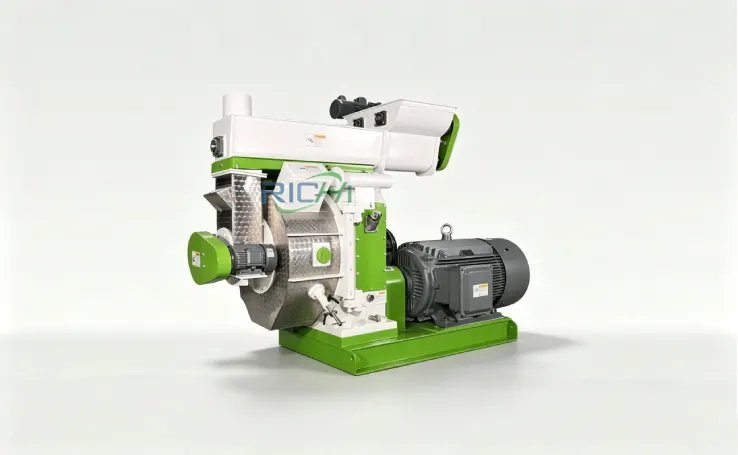
A pellet mill compresses prepared biomass through holes in a metal die.
During operation, rollers apply pressure to the material, forcing it through the die openings. The combination of pressure, friction, and heat helps compact the biomass into continuous strands, which are then cut into pellets.
Wood’s natural lignin can contribute to binding the particles together when appropriate processing conditions are maintained.
The diameter of the pellets is mainly determined by the die holes, while the final pellet length can be influenced by the cutting system.
Different pellet applications may require different dimensions. Therefore, the intended end use should be considered before selecting the die specification.
How Much Does a Wood Pellet Making Machine Cost?
A common question among new investors is how much does a wood pellet making machine cost?
There is no universal answer because pellet mills are available in different capacities and configurations. Machine price can vary according to production capacity, motor power, die size, construction, automation level, and the type of material being processed.
More importantly, the pellet mill is only one part of a complete production facility.
A commercial project may also require:
- Raw material handling equipment
- Wood chipper or crusher
- Hammer mill
- Dryer
- Pellet mill
- Pellet cooler
- Vibrating screen
- Conveyors
- Dust collection system
- Storage silos or bins
- Bagging equipment
- Electrical and control systems
Therefore, it is more useful to calculate the total project investment and estimated operating cost rather than comparing pellet mill purchase prices alone.
What Is Included in a Complete Wood Pellet Plant?
The configuration of a complete pellet plant depends on the feedstock and production target.
A relatively dry sawdust-based facility may use a process consisting primarily of screening, grinding, pelletizing, cooling, and screening.
A plant processing wet wood chips may require additional equipment for chipping and drying.
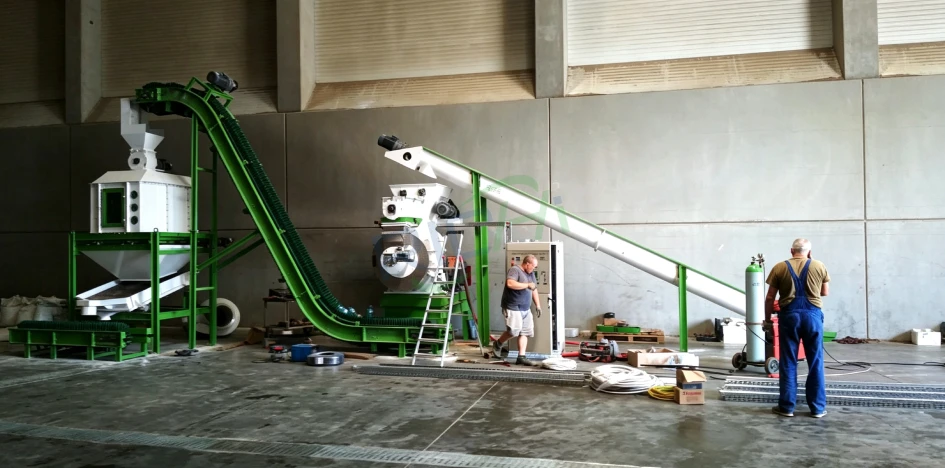
For high-capacity commercial facilities, automated conveying, centralized dust collection, storage systems, and automatic packaging can also be incorporated.
The main principle is to design the process around the raw material rather than starting with a machine and attempting to adapt everything else around it.
What Happens After Pellets Leave the Pellet Mill?
Freshly produced pellets are hot and relatively soft. They need to be cooled before they are stored or packaged.
A pellet cooler reduces the temperature of the pellets and helps stabilize their physical structure. This stage also contributes to reducing moisture and preventing excessive pellet breakage during subsequent handling.
After cooling, pellets are commonly screened to remove fines and broken pieces.
The fines can often be recycled into the production process rather than discarded. This helps improve product consistency while recovering usable biomass.
Why Is Pellet Screening Important?
Screening may appear to be a minor step, but it has an important role in final product quality.
During pelletizing and transportation, some pellets can break or generate fines. A screening machine separates these smaller particles from the finished product.
A well-designed screening stage can therefore provide a more uniform final product and improve the appearance and handling characteristics of packaged pellets.
For automated heating systems, consistent pellet size can also support more stable fuel feeding.
How Should a Wood Pellet Production Line Be Sized?
Production capacity should be determined by considering the entire process rather than looking only at the rated capacity of the pellet mill.
For example, a pellet mill may theoretically process a certain amount of material per hour under specific conditions. If the dryer, hammer mill, conveyor, or cooler cannot keep up, the actual plant output will be lower.
Important factors include:
- Raw material availability
- Moisture content
- Material density
- Particle size
- Pellet diameter
- Operating hours per day
- Number of pellet mills
- Dryer capacity
- Cooling capacity
- Storage requirements
A balanced production system is generally more useful than installing one high-capacity machine while leaving other process stages undersized.
What Should Be Considered When Building a Pellet Plant?
Site selection is another important part of project planning.
The location should provide sufficient space for raw material storage, production equipment, finished pellet storage, transportation, and maintenance access.
Electricity supply is also important because grinding, pelletizing, conveying, cooling, and other operations require power.
If a dryer is required, the project must also consider the available heat source and local environmental requirements.
Dust management should be incorporated into the layout from the beginning. Grinding and pellet handling can generate fine particles, so appropriate dust collection and ventilation systems are often required in industrial facilities.
How Can Pellet Production Costs Be Reduced?
Reducing production costs does not necessarily mean purchasing the cheapest equipment.
A more useful approach is to examine the entire production process.
For example, using a nearby and relatively dry raw material source can reduce transportation and drying costs. Proper particle-size control can reduce unnecessary grinding. Efficient motors and well-designed conveying systems can reduce electricity consumption.
Maintenance also affects long-term operating costs. Equipment that is difficult to maintain or frequently requires unscheduled downtime may have a higher total cost of ownership even if its initial purchase price is lower.
Energy consumption, spare parts, labor, maintenance, and raw material logistics should therefore all be included when evaluating a project.
What Safety Issues Should a Pellet Plant Address?
Wood processing produces combustible dust, particularly during grinding, conveying, and screening.
For this reason, industrial pellet facilities should take dust control and fire safety seriously. Depending on the local regulations and facility design, this may involve dust collectors, enclosed conveying systems, ventilation, grounding, monitoring equipment, and appropriate fire-protection measures.
Good housekeeping is also essential. Dust should not be allowed to accumulate around machinery or electrical systems.
Specific safety requirements differ between countries and facilities, so project owners should work with qualified engineers and comply with applicable local standards.
Is a Small Wood Pellet Plant Different From a Commercial Plant?
Yes. Scale has a major influence on equipment configuration.
A small producer may use a simpler system if the raw material is already dry and properly sized. Manual or semi-automatic handling may also be practical at lower production volumes.
A commercial facility, on the other hand, usually needs greater automation and more comprehensive material handling.
Large-scale operations may incorporate multiple pellet mills, industrial dryers, automated storage, centralized dust collection, automatic packaging, and computerized control systems.
The appropriate configuration should therefore reflect actual production requirements instead of simply selecting the largest available machine.
What Questions Should You Ask a Pellet Equipment Supplier?
Before investing in equipment, buyers should collect detailed information about the proposed system.
Useful questions include:
1. What raw materials can the equipment process?
Ask whether the supplier has experience with the specific wood residue available at your site.
2. What moisture range is recommended?
This helps determine whether drying equipment will be necessary.
3. What is the realistic production capacity?
Capacity should be discussed in relation to the actual raw material rather than an ideal test condition.
4. What is the expected power consumption?
Electricity can represent a significant operating cost over the lifetime of a plant.
5. What auxiliary equipment is required?
The pellet mill should be evaluated as part of the complete process.
6. What maintenance is required?
Ask about die replacement, roller maintenance, lubrication, spare parts, and routine servicing.
7. Can the plant be expanded later?
Future expansion may be important if raw material availability or market demand increases.
Where Can You Learn More About Pellet Equipment Manufacturers?
Researching suppliers is an important step before making a technical decision.
Instead of focusing only on product photographs or headline specifications, prospective buyers can examine equipment configurations, technical documentation, project experience, manufacturing capabilities, and after-sales support.
Those interested in learning more about the company and its background can visit site through the manufacturer’s About Us page for additional information.
This type of background research can help buyers understand whether a supplier has experience relevant to their specific project.
Is Wood Pellet Production Economically Practical?
The economic feasibility of a pellet project depends on local conditions.
Important variables include raw material cost, transportation distance, moisture content, electricity prices, fuel costs, labor, equipment investment, maintenance, storage, and the selling price of finished pellets.
The availability of stable raw materials is particularly important. A pellet plant requires a consistent supply of suitable biomass to maintain regular production.
Transportation can also have a major impact. Wood residues are relatively bulky before densification, so transporting them long distances can increase logistics costs.
For this reason, many project evaluations begin by analyzing the local biomass supply before determining the final plant capacity.
What Are the Main Benefits of Producing Wood Pellets?
Densifying biomass into pellets can provide several practical advantages.
First, pellets occupy less volume than the original loose material for the same mass of biomass. This can simplify transportation and storage.
Second, their standardized shape allows automated feeding systems to handle them more easily.
Third, pellet production can create a useful fuel product from certain wood-processing residues that might otherwise have limited applications.
However, these benefits depend on responsible raw material sourcing, appropriate production technology, efficient logistics, and suitable end-use applications.
Frequently Asked Questions About Wood Pellet Production
What is the main raw material for wood pellets?
Sawdust, wood shavings, planer dust, and clean wood-processing residues are among the most common raw materials. The material should be suitable for pelletizing and free from harmful contaminants.
Do wood pellets require additives?
Clean wood can often be pelletized using its natural binding properties, particularly lignin. Whether additives are needed depends on the raw material and the required pellet specifications.
How long does it take to build a pellet plant?
The timeline varies according to plant capacity, equipment configuration, site conditions, installation requirements, and the degree of automation. A complete commercial project generally involves equipment manufacturing, transportation, installation, commissioning, and testing.
What size are wood pellets?
Pellet diameter depends mainly on the die specification. Different heating and industrial applications may use different pellet dimensions, so the target market should be considered when selecting equipment.
Can sawdust be pelletized without drying?
It can be, provided that its moisture content is already within a suitable range for the pelletizing process. If the material is too wet, drying may be required.
Are wood pellets renewable fuel?
Wood pellets are generally categorized as a biomass fuel because they are produced from biological material. Their overall environmental performance, however, depends on factors such as feedstock sourcing, land management, processing energy, transportation, and the combustion application.
What is the most important factor in pellet production?
There is no single factor that determines the performance of every plant. Raw material quality, moisture, particle size, equipment configuration, operating conditions, and process balance all contribute to the final result.
Final Thoughts
A wood pellet plant is best understood as an integrated processing system rather than a single machine. Raw material preparation, moisture control, grinding, pelletizing, cooling, screening, storage, and material handling all need to work together.
For anyone considering a new project, the most practical starting point is to analyze the available biomass first. Once the material characteristics and supply volume are understood, it becomes much easier to determine the required process flow, equipment capacity, and investment level.
Companies researching complete biomass processing solutions may also find RICHI Machinery useful as one manufacturer to include in their supplier research. Comparing technical configurations and asking detailed questions about actual operating conditions can provide more meaningful information than comparing equipment prices alone.
Ultimately, a well-planned pellet project is built around the relationship between raw materials, technology, energy consumption, logistics, and the intended market. Taking time to evaluate these factors before purchasing equipment can help create a production system that is technically practical and easier to operate over the long term.