
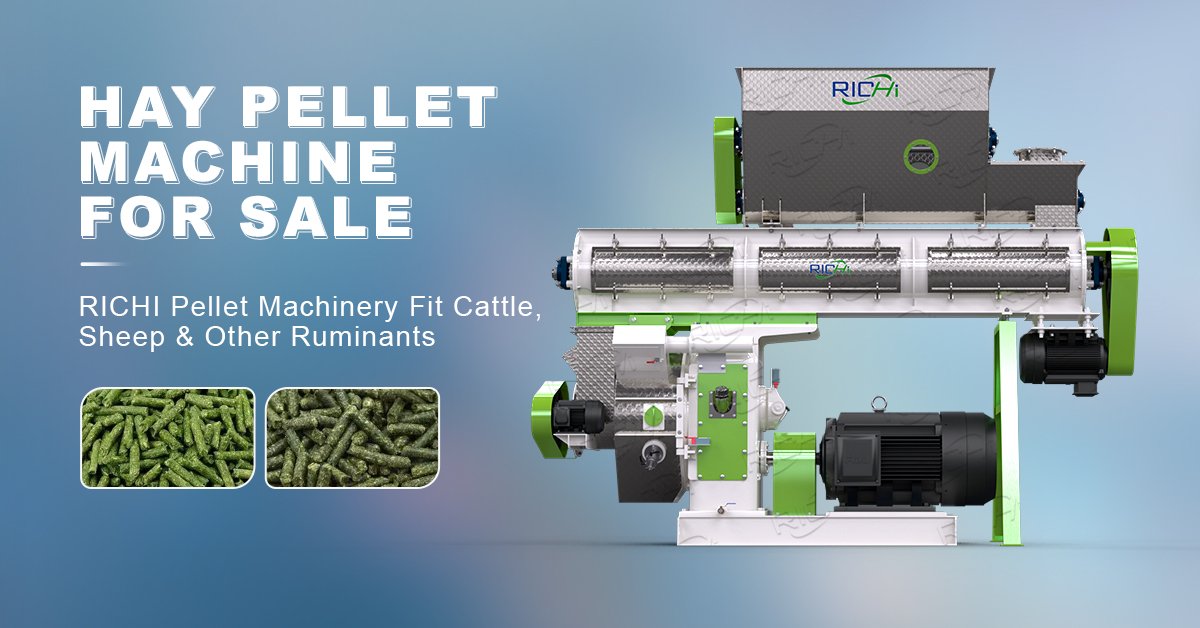
For livestock producers, the value of alfalfa is well understood. It is widely used as a forage source for dairy cattle, beef cattle, horses, sheep, goats, rabbits, and other animals. Yet the way alfalfa is harvested, stored, transported, and fed can have a major influence on its practical value.
Freshly harvested forage is bulky. Hay can take up considerable storage space and may lose quality when exposed to unsuitable weather or storage conditions. Loose forage can also be difficult to handle efficiently on farms with large animal populations.
This is where pelleting technology becomes interesting.
By converting properly prepared alfalfa into compact pellets, producers can create a more uniform feed material that is easier to store, transport, measure, and distribute. For businesses considering this approach, an alfalfa pellet mill for sale can become part of a broader feed-processing strategy rather than simply another piece of farm equipment.
Why Is Alfalfa Such an Interesting Pellet Feedstock?
Alfalfa has a naturally valuable nutritional profile, which makes it an important forage ingredient in many animal feeding programs.
However, the raw plant is not always convenient to manage.
Depending on harvesting methods, alfalfa may be available as:
- Fresh-cut forage
- Dried hay
- Hay flakes
- Chopped alfalfa
- Alfalfa meal
- Fine processing residues
Each form presents different handling characteristics.
Loose hay may require large storage areas. Fine alfalfa meal can create dust and may be difficult to transport efficiently. Pellets provide another physical format.
Pelletizing does not magically increase the nutritional value of alfalfa, but it can improve the physical characteristics of the feed. This distinction is important when evaluating the technology.
The objective is to make a feed product that is convenient and consistent without unnecessarily damaging the nutritional quality of the forage.
From Hay Field to Feed Pellet
An alfalfa pellet project generally begins long before the pellet mill.
The first question is: what condition is the alfalfa in when it reaches the processing facility?
If the forage has already been dried and chopped, the preparation system can be relatively straightforward.
If it contains excessive moisture or large pieces, additional processing may be required.
A typical process can include:
Harvesting → Drying → Chopping → Grinding → Conditioning → Pelletizing → Cooling → Screening → Packaging
Not every project requires all of these stages.
The correct process depends on the condition of the raw material.
For example, very dry hay may only need size reduction before pelletizing, while freshly harvested material may require significant moisture reduction.
Why Moisture Management Matters
Moisture is one of the most important variables in forage pellet production.
If the feedstock is too wet, pellet formation may become unstable. Excess moisture can also create problems during storage.
If the material is excessively dry, however, the pelletizing process may also become less efficient.
The ideal condition depends on the equipment and raw material.
This means operators should rely on actual moisture measurements rather than visual judgment.
Seasonal changes can also be important.
Alfalfa harvested during dry weather may behave differently from material harvested after rainfall. Storage conditions can also change moisture levels.
A commercial pellet plant therefore benefits from routine moisture monitoring.
Choosing the Right Production Capacity
Capacity selection is one of the most important decisions when planning an alfalfa pellet project.
A farm with limited forage production does not necessarily benefit from a large industrial system.
On the other hand, a commercial feed manufacturer supplying multiple farms may require significantly higher throughput.
A smaller operation may consider a 1-2 T/H hay pellet machine for sale when the objective is to process locally available forage at a manageable scale.
A larger facility might require several production stages operating continuously.
The key is not to choose the biggest available machine.
Instead, production capacity should be based on:
- Annual alfalfa availability
- Seasonal supply
- Daily feed demand
- Expected operating hours
- Storage capacity
- Local market demand
- Expansion plans
A machine that is correctly sized and consistently utilized can often be more practical than an oversized system running below its economic capacity.
What Happens Inside the Pellet Mill?
During pelletizing, prepared alfalfa is compressed through a die under mechanical pressure.
The combination of pressure and friction can generate heat, helping natural components of the plant contribute to pellet formation.
The final pellet characteristics depend on several variables.
These include:
- Fiber length
- Moisture
- Particle size
- Feed composition
- Die specifications
- Compression conditions
- Feeding rate
- Machine settings
This is why pellet production should be treated as a process rather than a single mechanical operation.
Changing the raw material can change the ideal operating conditions.
Pellet Size and Animal Requirements
One advantage of pelletizing is the ability to produce standardized feed particles.
The appropriate diameter depends on the target animal and feeding system.
For example, feed intended for smaller animals may require a different pellet size from material intended for cattle.
Horse owners may also have different preferences from commercial dairy farms.
The final product should therefore be designed around the feeding application.
Instead of asking only how many tons per hour the machine can produce, a buyer should also determine:
What animal will consume the pellets?
What pellet diameter is appropriate?
Will the pellets be fed directly or included in another ration?
These questions can influence the equipment configuration.
Why Pellets Can Simplify Feed Logistics
Feed handling is an important but sometimes overlooked part of livestock production.
Loose hay requires considerable space.
Pellets are much more compact and can be handled using bins, bags, conveyors, and automated feeding systems.
This can be particularly useful for larger livestock operations.
For example, a commercial farm may store pelletized forage in a dedicated feed room and distribute measured quantities according to the feeding schedule.
The standardized physical form can also make inventory management easier.
Instead of estimating how much loose forage remains, operators can measure feed by weight.
Pellets and Feed Consistency
Consistency is another important benefit.
Loose forage can vary considerably in particle length and composition.
Pelletizing creates a more uniform physical product.
This does not eliminate nutritional variation in the original crop, but it can improve physical uniformity.
For feed manufacturers, this may simplify downstream blending.
Alfalfa pellets can potentially be used as:
- Direct forage feed
- A protein-rich ingredient
- A component in complete feed
- A supplement ingredient
- A raw material for mixed feed pellets
The actual application depends on formulation requirements and animal nutrition strategy.
Beyond the Pellet Mill: Supporting Equipment
A pellet mill machine is the core machine, but a commercial operation normally needs supporting equipment.
Depending on the project, the system may include:
Hammer Mill
Used to reduce chopped alfalfa to a suitable particle size.
Dryer
Required when incoming material contains excessive moisture.
Conditioner
Can help prepare material before pelletizing.
Cooler
Reduces pellet temperature after production.
Screener
Separates fines and broken pellets from finished product.
Packing Machine
Allows pellets to be sold in standardized bags.
Conveyors
Transfer material between different processing stages.
For larger projects, industrial animal feed equipment for sale may include automated feeding, weighing, mixing, and packaging systems.
(Related Post:https://www.richipelletmill.com/animal-feed-mill-equipment-for-sale/)
The final equipment list should be determined by the production process rather than by adding machinery simply because it is available.
Is Alfalfa Pellet Production Only for Feed Mills?
No.
There are several possible business models.
Farm-Based Production
A large farm can process its own alfalfa into pellets for internal consumption.
Cooperative Production
Several farms can share a processing facility and combine their forage resources.
Commercial Feed Manufacturing
A dedicated feed company can manufacture alfalfa pellets for sale.
Agricultural Residue Processing
A company may process alfalfa alongside other suitable forage materials.
Each model requires different investment and capacity planning.
How Can Farmers Evaluate the Economics?
The first step is calculating the true raw material cost.
If a farm already produces alfalfa, the economic calculation differs from a company purchasing dried hay from external suppliers.
Important costs include:
- Harvesting
- Drying
- Transportation
- Grinding
- Electricity
- Labor
- Packaging
- Maintenance
- Storage
- Equipment depreciation
The final selling price should then be compared with these expenses.
Pellet production can improve logistics, but it is not automatically profitable simply because pellets have a higher selling price than loose hay.
The entire production cost matters.
Storage Advantages
Storage is one area where pelletization can offer practical benefits.
Loose forage occupies considerable volume and may require large barns.
Pellets can be stored in bags, bulk bins, or suitable warehouses.
However, pellets still require proper storage.
Moisture should be controlled, and the storage environment should be clean and dry.
Feed should also be protected from contamination.
Good storage management helps preserve the physical quality of the finished product.
Can Pellets Reduce Feed Waste?
Potentially, depending on the feeding system.
Long, loose forage can sometimes be wasted during feeding.
Pellets can be portioned more precisely, especially when automatic or controlled feeding systems are used.
However, feed waste depends on many factors, including animal behavior, ration design, storage, and feeding management.
Pelletizing should therefore be viewed as one tool within a broader feed-efficiency strategy.
Planning for Future Growth
An alfalfa pellet operation should not be designed only for today’s production volume.
If the farm expects to expand its livestock population or add outside customers, future capacity may become important.
A scalable factory layout can reserve space for additional equipment.
Electrical systems, conveyors, storage, and packing systems can also be planned with future expansion in mind.
This can make later upgrades easier.
Final Considerations
Alfalfa pellet production is fundamentally about turning a bulky forage resource into a standardized feed product.
The value comes not only from the pellet itself but from the improvements in handling, storage, transportation, dosing, and production consistency.
Before investing, producers should examine the raw material condition, expected capacity, target animals, pellet specifications, and complete production economics.
Equipment information is widely available, but buyers should compare technical solutions based on their own feedstock and production goals. Those researching different configurations can discover this info here as part of their preliminary equipment research.
The best alfalfa pellet project is not necessarily the largest or most automated.
It is the one that connects reliable forage supply, suitable machinery, realistic capacity, and a clear feeding or commercial market into one efficient system.