
If you raise pigs, you know the drill. You buy feed, you haul it to the barn, you pour it into the feeders, and the pigs eat. It seems simple enough. But if you have ever stopped to look closely at what you are feeding, you might have noticed something. Not all pig feed is the same. Some comes as a fine, dusty mash. Some comes as hard, uniform pellets. Some is crumbled into small pieces. The form of the feed affects how pigs eat it, how they digest it, and how efficiently they convert it into weight gain. And that affects your bottom line.
For years, the conventional wisdom was that mash was good enough. Pigs would eat it, they would grow, and that was that. But as feed costs have risen and margins have tightened, more producers have started asking harder questions. Is there a better way to feed pigs? Does the form of the feed actually matter? And if it does, what is the best option for a commercial operation?
The Problem with Mash
Mash is the simplest form of feed. It is ground grain, protein meal, minerals, and vitamins mixed together. It is easy to produce. You grind, you mix, and you are done. No pelleting, no conditioning, no cooling. The equipment is simpler, and the cost is lower. That is why mash has been the default choice for many small and medium-sized operations.
But mash has drawbacks. It is dusty. The fine particles become airborne, which can irritate the respiratory systems of both pigs and workers. It does not flow well through feeders. It tends to bridge and clump, especially in humid conditions. And it is easy for pigs to sort through. They will pick out the bits they like and leave the rest behind. That means they are not getting a balanced ration. They are getting a partial ration, and the rest is wasted.
Mash also has a lower nutrient density than pellets. A pound of mash takes up more space than a pound of pellets. That means more storage, more handling, and more transportation cost per unit of nutrition. For a large operation, those costs add up.
What Pelleting Does
Pelleting changes the physical form of the feed. The ingredients are ground, mixed, conditioned with steam, and forced through a die under high pressure. The friction generates heat, which gelatinizes the starches and binds the particles together. The result is a dense, uniform pellet that is easy to handle, easy to store, and easy to feed.
Pellets offer several advantages over mash. First, they reduce waste. Pigs cannot sort through pellets the way they can sort through mash. Every pellet contains the same balance of nutrients. The pigs eat the whole ration, not just the parts they prefer. Second, pellets flow better. They do not bridge or clump in feeders. They can be stored in bins and augered without clogging. Third, pellets are denser. They take up less space, which reduces storage and transportation costs. Fourth, the heat of pelleting improves digestibility. The gelatinized starches are easier for the pig to break down. The protein is partially denatured, which improves amino acid availability. The result is better feed conversion. Pigs gain more weight on less feed.
The Science Behind the Pellet
The benefits of pelleting are not just anecdotal. They have been studied extensively. Research has shown that pigs fed pelleted diets consistently outperform pigs fed mash. The improvement in feed conversion is typically 5% to 10%. In some studies, it has been even higher. For a commercial operation, that difference is significant. If you are spending $100,000 a year on feed, a 7% improvement in feed conversion saves you $7,000. Over the life of the equipment, that adds up.
The pelleting process also affects the pig’s digestive system. The heat and pressure break down some of the fibrous structures in the feed. This makes the feed easier to digest and reduces the amount of undigested material passing through the gut. The result is less manure, which means less waste management and lower environmental impact.
Pellets also reduce the risk of feed sorting. When pigs eat mash, they can pick out the corn and leave the soybean meal. They can eat the fat and leave the minerals. This selective feeding leads to nutritional imbalances. Some pigs get too much of one nutrient and not enough of another. The result is uneven growth and poor performance. Pellets eliminate this problem. Every pig gets the same balanced ration with every bite.
The Equipment That Makes It Happen
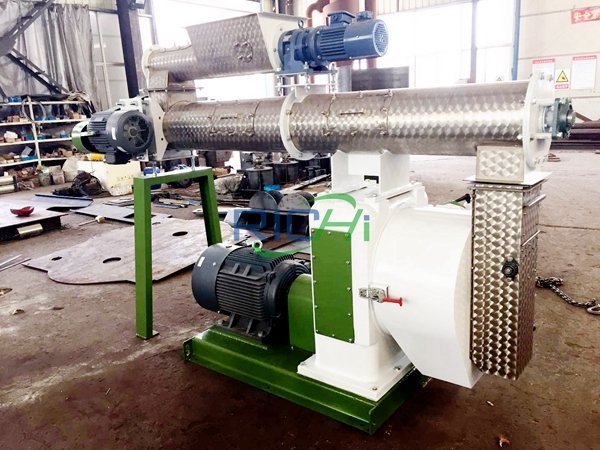
A pig feed pellet machine is the centerpiece of any pelleting operation. These machines come in different sizes and configurations. Small machines might produce a few hundred kilograms per hour, suitable for a farm that wants to process its own feed. Larger machines can produce several tons per hour, suitable for commercial feed mills or large integrated operations.
The key components of a pig feed pellet machine are the die, the rollers, the conditioner, and the drive system. The die is a thick metal ring with precision-drilled holes. The rollers press the material through the die. The conditioner adds steam to soften the fibers and activate the natural binders. The drive system provides the power. The control system manages the feed rate, temperature, and pressure to maintain consistent pellet quality.
The die is the most important component. It determines the pellet size and density. It also wears out over time. Pig feed is abrasive, especially when it contains mineral supplements or fibrous by-products. A die made from standard steel will wear out quickly. A die made from wear-resistant alloy will last longer and produce more consistent pellets. The choice of die material affects both the quality of the feed and the cost of production.
Scaling Up: The Industrial Option
For operations that need to produce feed at commercial scale, a single pellet machine is not enough. You need a complete system. A 1-40T/H industrial feed pellet machine is designed for high-volume production. These machines can process 1 to 40 tons per hour, depending on the configuration and the material. They are built for continuous operation, with heavy-duty components and automated controls. They are used in commercial feed mills, large integrated operations, and cooperatives that serve multiple farms.
The industrial feed pellet machine is not just bigger. It is more sophisticated. It includes advanced conditioning systems that precisely control temperature and moisture. It includes automated controls that monitor the process and adjust parameters in real time. It includes safety systems that shut down the machine if something goes wrong. It is designed to run 24 hours a day, seven days a week, with minimal downtime.
The investment in an industrial machine is significant. But the economics can be compelling. The per-ton cost of production decreases as the volume increases. A large machine can produce feed at a lower cost per ton than a small machine. That cost advantage can be passed on to customers or retained as profit.
The Complete Line
A pellet machine on its own does not make a production line. It is one component of a system that includes grinding, mixing, conditioning, pelleting, cooling, and screening. A complete pellet line integrates all of these stages into a coordinated flow. Each stage affects the quality of the final product. If any stage is undersized or poorly matched, the whole line suffers.
Grinding is the first step. A hammer mill reduces the grain to a consistent particle size. The particle size affects the pellet quality and the digestibility of the feed. If the grind is too coarse, the pellets will be weak. If it is too fine, the pellets may be too dense and less palatable.
Mixing is the second step. A mixer blends the ground grain with protein meal, minerals, vitamins, and other additives. The mixing must be thorough to ensure that every pellet contains the same balance of nutrients. If the mixer is not thorough, the feed will be inconsistent, and the pigs will perform unevenly.
Conditioning is the third step. Steam is added to the mixed material to soften the fibers and activate the natural binders. The temperature and moisture must be controlled precisely. Too little conditioning produces weak pellets. Too much makes the material sticky and difficult to press.
Pelleting is the fourth step. The conditioned material is forced through a die to form pellets. The die hole diameter determines the pellet size. The compression ratio determines the pellet density and durability. The pellet mill must be matched to the material and the production goals.
Cooling is the fifth step. The hot pellets are cooled to ambient temperature. Cooling hardens the pellets and reduces moisture to a safe level for storage. If the pellets are not cooled properly, they will sweat and mold in storage.
Screening is the sixth step. The cooled pellets are screened to remove fines and broken pieces. The fines are recycled back into the process. Screening ensures that the finished product meets the size and quality specifications expected by the market.
What to Look For in a Supplier
The equipment is only part of the equation. The supplier behind it matters just as much. A good supplier will help you design a line that fits your operation. They will ask about your raw material, your capacity goals, and your market. They will recommend the right configuration and the right level of automation. They will provide installation, training, and support.
Before you buy, ask the supplier these questions. What is the actual capacity with my material? What die configuration do you recommend and why? What is the expected die life? What spare parts should I keep on hand? What training do you provide? What support do you offer after the sale? The answers will tell you a lot about the supplier and the equipment. A supplier who hesitates or gives vague answers is not the one you want to work with. A supplier who engages with your questions and provides specific, detailed answers is the one you want.
It also helps to visit a working installation. See the equipment in operation. Talk to the operators. Watch how the pellets come out. Ask about maintenance and downtime. A firsthand look will tell you more than any brochure. If you cannot visit, ask for references from other customers and call them. Their experience will tell you more than any sales pitch.
For more detailed information on equipment specifications, capacity options, and supplier comparisons, find out this here to explore the resources that can help you make an informed decision.
The Bottom Line
The form of the feed matters. Pellets offer advantages over mash that translate directly into better performance and lower costs. The equipment to produce pellets is available at different scales. Whether you are a small farm processing your own feed or a commercial operation supplying multiple farms, there is a pellet machine that fits your needs.
The technology is proven. The market is established. The question is whether you are ready to take the step. If you are tired of watching your feed bill climb while your pigs sort through their rations, it may be time to consider a different approach. The answer might be simpler than you think.